
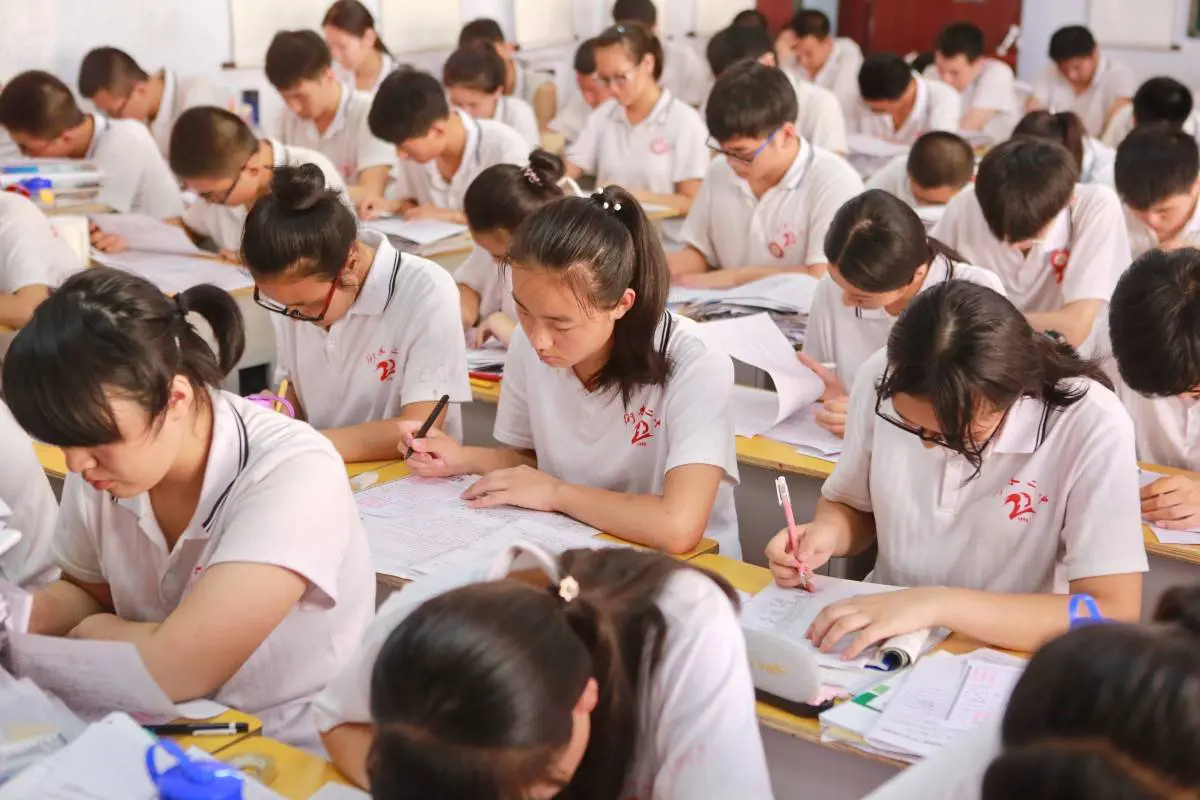
 eenagers from China’s wealthiest regions have outdone students in some of the richest countries of the world in an annual international test taken for reading, math and science. The results show that most 15-year-old Chinese students aced the test in all three categories, achieving the maximum highest level 4 rating. Majority of the students belonged to Beijing, Shanghai, and the eastern provinces of Jiangsu and Zhejiang.The findings were reported following the results of the 2018 Program International Student Assessment (PISA), an international standardized testing that gauges the efficacy of education systems around the world. The test is conducted every three years by the Organization for Economic Cooperation and Development (OECD), a body of the world’s richest economies.Chinese students’ rise to the top meant that the previous test’s leader, Singapore, was pushed to the second spot. For years, Singapore’s education system has been ranked as one of best in the world, with its students regularly featured at the top of various global educational tests. However, the study said that the difference in Singapore’s scores compared to the four Chinese regions was not “statistically significantly different”.Students in the US were ranked at level 3 for reading and science, and level 2 for math. British teens achieved a level 3 ranking in all three categories.
Selected Performance?
Although China’s success is nothing but remarkable, it has nonetheless drawn criticism for not exactly representing the overall ability of Chinese student body. Considering that the test only accounted for four wealthy Chinese regions, it is safe to say that the results do not indeed present a wider picture of the Chinese education system. There are millions of students enrolled in schools across the rest of China, with a major chunk of that student body living in rural areas.
15-year-old Chinese students aced reading, math and science categories in PISA 2018 test, outshining peers from some of the richest countries in the world
For the test’s 2012 iteration, PISA only tested Chinese students from the Shanghai region. Although the results were impressive, PISA did draw flak for misrepresenting the Chinese education system and its effectiveness. In 2015, four provinces were included – Shanghai, Beijing, Jiangsu and Guangdong.In the 2018 PISA report, OECD Secretary-General Angel Gurria said the performance of Chinese students was highly impressive given that the average income levels in those regions were below the OECD average.These four provinces/municipalities in eastern China are far from representing China as a whole, but the size of each of them compares to that of a typical OECD country, and their combined populations amount to over 180 million,” he said. “The quality of their schools today will feed into the strength of their economies tomorrow.”
Only A Gauge
According to PISA, the test’s aims are far from initiating a competitions between nations or show who is better. Rather, the test is an important means to provide “useful information to educators and policy makers concerning the strengths and weaknesses of their country’s education system”.“When ranking countries, economies and education systems in PISA, it is important to consider the social and economic context in which education takes place,” the report said.The 2018 PISA test was attempted by a record 600,000 students across 79 countries and territories, the OECD said.In Europe, the top honors went to a surprise candidate – Estonia. Estonia outshone major European economies, including the UK. Estonia was placed third in science, while the UK was 15th. In reading, Estonia was ranked sixth, while UK lagged far behind at the 22nd place.
[/vc_column_text][/vc_column][/vc_row]