

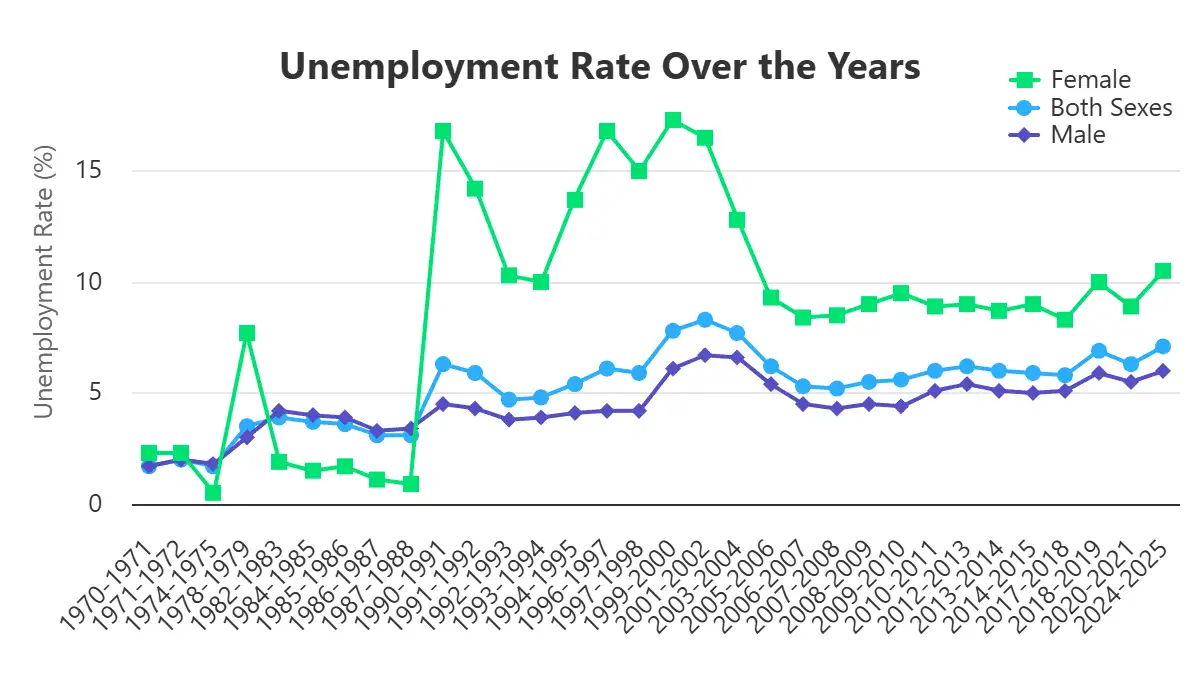
A new analysis of the latest Labour Force Survey 2024-25 released by the Pakistan Bureau of Statistics (PBS) has revealed a concerning paradox in Pakistan’s labour market: as women attain higher levels of education, their likelihood of unemployment significantly increases.
The findings paint a troubling picture of the country’s employment landscape, where nearly one in four highly educated women remains jobless despite years of academic achievement. The data shows a clear upward trend in unemployment rates corresponding with rising educational qualifications.
Women with no formal education experience a relatively low unemployment rate of 4.7 percent. However, the rate nearly doubles to 9.0 percent for those with education below matriculation and climbs further to 15.5 percent among women who have completed matriculation.
The situation becomes more acute at higher education levels. Women holding intermediate qualifications face an unemployment rate of 23.6 percent. This trend continues among graduates, with 23.8 percent of bachelor’s degree holders unemployed, while the figure peaks at 23.9 percent for women possessing master’s degrees, M.Phil, or PhD qualifications.
These findings challenge the long-held assumption that higher education guarantees better employment prospects. Instead, experts point to structural issues within Pakistan’s labour market as the primary cause of this disconnect.
Analysts highlight a severe shortage of white-collar job opportunities, a growing mismatch between academic curricula and market demands, and the slow expansion of high-productivity sectors capable of absorbing skilled labour. Additionally, entrenched social norms and safety concerns continue to restrict women’s participation in the workforce, further compounding the issue.
The report underscores a widening gap between educational attainment and employment opportunities. While female enrollment and academic success have improved significantly in recent years, the pace of job creation—particularly in formal and high-skill sectors—has not kept up.
Experts warn that without immediate and targeted policy interventions, the trend could worsen. Recommended measures include creating more jobs in knowledge-based industries, strengthening private sector growth, ensuring safer and more inclusive workplaces, and developing effective transition pathways from education to employment.
Related: Girls education gap widens across Pakistan
The analysis concludes that unless Pakistan achieves parallel growth in professional sectors, higher education for women may continue to be associated with increased unemployment, raising critical questions about the country’s economic planning and labour market dynamics.