

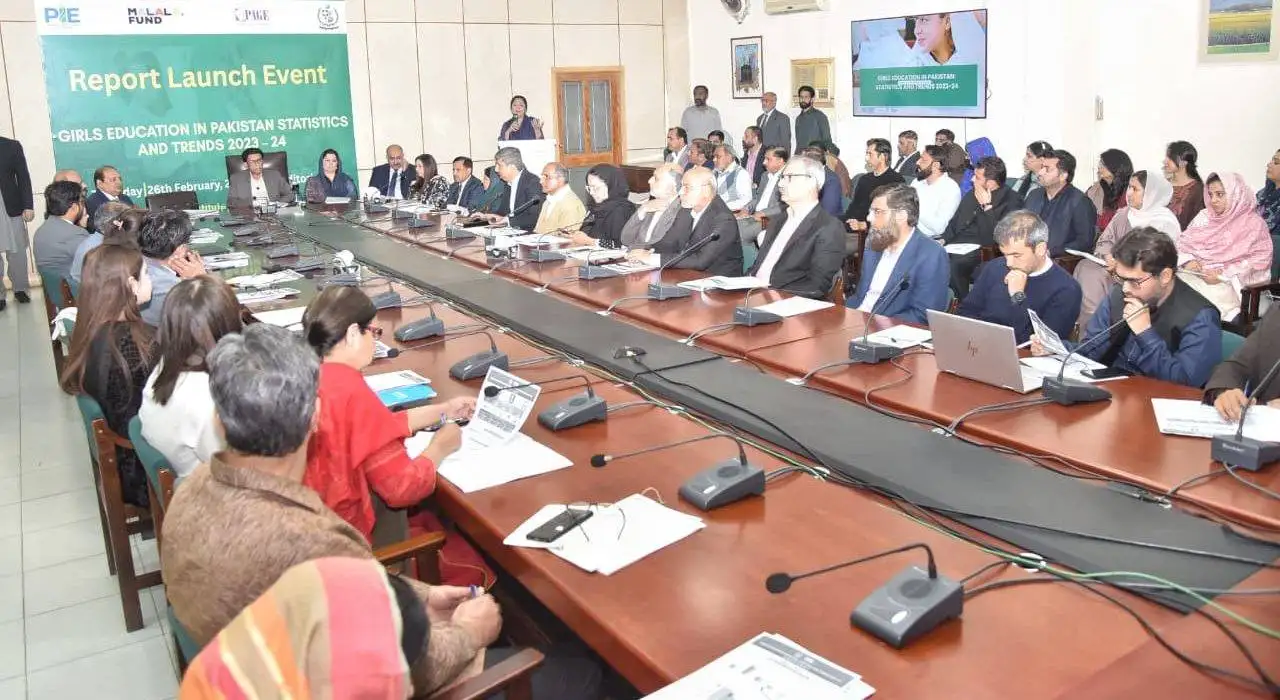
Pakistan is grappling with a severe education emergency, as new data reveals that 26.2 million children across the country are currently out of school, highlighting an urgent need for comprehensive reforms to ensure both access to and quality of education for the nation’s most vulnerable populations.
The alarming statistics were presented in the “Girls Education Statistics and Trends Report 2023-24 (GESTR),” launched in Islamabad by Federal Minister for Education and Professional Training (MoFEPT) Khalid Maqbool Siddiqui. The report is a collaborative effort by the Pakistan Institute of Education, the Malala Fund, the Pakistan Alliance for Girls Education, and the Ministry of Education.
According to the report, 25.37 million children aged between 5 and 16 are deprived of schooling, placing Pakistan among the countries with the highest number of out-of-school children globally, as highlighted by UNICEF. The data reveals a pronounced gender gap, with 13.41 million girls and 11.96 million boys currently not enrolled in educational institutions.
A provincial breakdown shows significant disparities across the country. Punjab accounts for the largest number, with 9.6 million out-of-school children, including 4.83 million girls. Sindh follows with 7.82 million children, including 4.09 million girls. Khyber Pakhtunkhwa has 4.92 million children out of school, while Balochistan records 2.94 million, including 1.53 million girls. Even in the federal capital, Islamabad, approximately 90,000 children are out of school, including 40,000 girls.
The report also paints a troubling picture of student retention, with sharp declines in enrollment as students advance through educational levels. While more than 20.8 million children enroll at the primary level, the number drops to 9.2 million at middle school, 4.69 million at matriculation, and just 2.82 million at the intermediate level. At the university level, enrollment falls drastically to 718,000 students.
Gender-wise data shows that although enrollment is relatively balanced at the primary level, both boys and girls experience significant dropouts in later stages. However, a notable shift occurs at the higher education level, where female enrollment surpasses male enrollment, with 428,000 women compared to 290,000 men, indicating gradual progress in women’s access to higher education despite earlier challenges.
Despite the grim outlook, the report highlights some improvements in school infrastructure. Around 96 percent of schools now have permanent buildings, 92 percent are equipped with toilets, and 82 percent provide access to clean drinking water. The primary completion rate for girls has also improved significantly, rising from 75 percent to 89 percent.
However, major systemic challenges persist. Rapid population growth has reduced the number of schools per 1,000 children, limiting access to education. Only 23 percent of schools are equipped with ramps for children with disabilities, and even fewer provide specialized learning materials. Digital access remains limited, with just 19 percent of schools having digital devices. Teacher training is another area of concern, as only 23 percent of teachers in girls’ schools have received foundational training.
Financial constraints further compound the crisis. The share of the education budget has declined from 13 percent to 11 percent, with approximately 94 percent of funds allocated to salaries, leaving minimal resources for development, infrastructure, and quality enhancement initiatives. Experts warn that without increased investment and structural reforms, progress in the education sector will remain slow and uneven.
The report also underscores a critical disconnect between education and economic participation. While women are gradually achieving parity in higher education enrollment, their participation in the labour force remains stagnant at just 24 percent, reflecting broader socio-economic barriers that limit the impact of educational gains.
Related: Pakistani Scholars Urge Taliban to Reopen Schools for Girls
Education experts stress that addressing Pakistan’s education crisis requires urgent policy attention, increased funding, improved teacher training, enhanced infrastructure, and targeted interventions to reduce gender disparities and dropout rates. Without decisive action, millions of children risk being left behind, threatening the country’s future development and economic stability.