
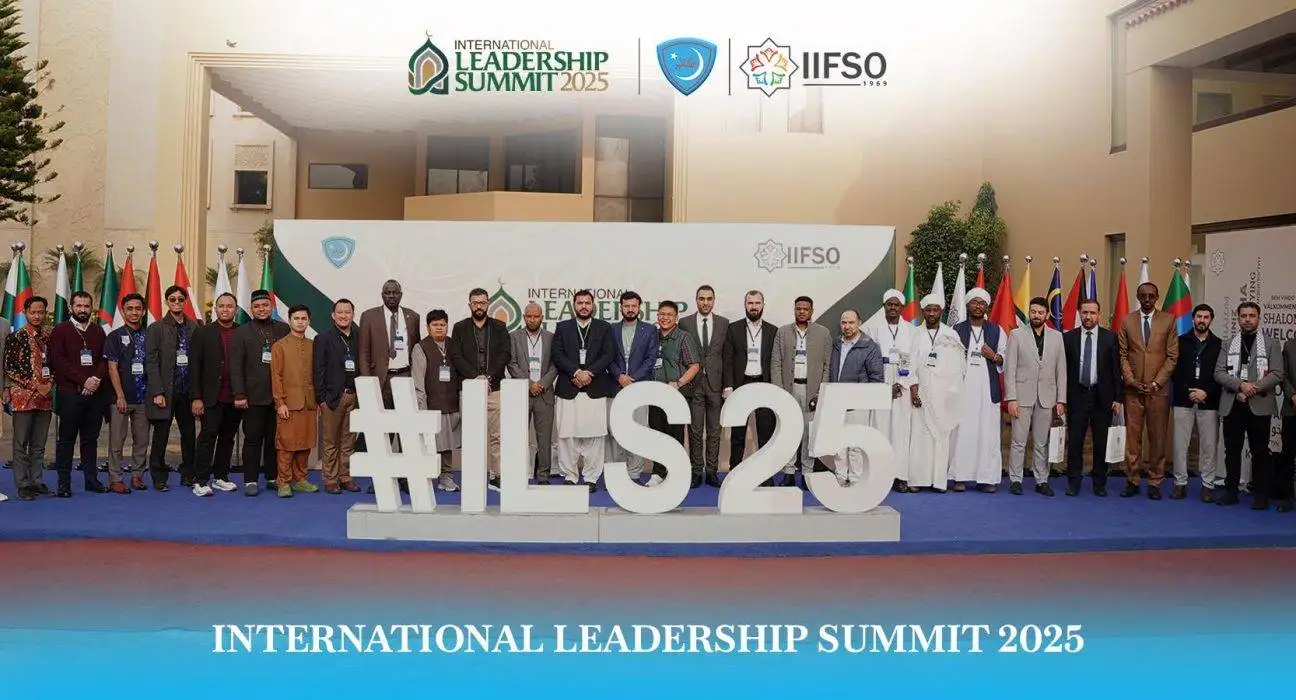
The International Leadership Summit 2025 concluded in Islamabad after in-depth deliberations aimed at strengthening youth leadership, intellectual development, and global awareness among student organizations from across the Muslim world. Hosted by Islami Jamiat-e-Talaba Pakistan (IJT) in collaboration with the International Islamic Federation of Student Organizations (IIFSO), the summit marked a shift toward a more qualitative and strategic approach, prioritizing youth intellectual building and leadership qualification before engaging with global political dynamics.
The summit opened in an atmosphere of inclusivity and dialogue, with IJT President Hassan Bilal Hashmi welcoming delegates and outlining the intellectual framework of the gathering. In his remarks, Hashmi emphasized the importance of unifying visions among student leaders and renewing collective commitments, noting that Islamabad’s hosting of the event reflected IJT’s resolve to foster meaningful engagement and constructive exchange of ideas among youth organizations.
Leadership development emerged as the central theme of the summit, with participants stressing the need for values-based and competent leadership in a rapidly changing world. Dr. Khalid Rehman, Chairman of the Institute of Policy Studies Islamabad, addressed the session titled “Empowering the Next Generation: What Makes an Ideal Youth Leader?” He highlighted the need for young leaders to possess both professional skills and strong ethical foundations, enabling them to navigate global complexities while remaining committed to societal values.
Building on this foundation, discussions turned to the evolving international landscape and its implications for emerging leaders. Senator Mushahid Hussain Sayed, Information Secretary of the Pakistan Muslim League, delivered a lecture on “Shifting Centers of Power: Understanding the Emerging World Order and Its Effects.” He observed that the global system is moving away from unipolarity toward a more fluid balance of power, underscoring the responsibility of young leaders to understand these changes in order to safeguard the strategic interests of the Muslim world.
Providing a data-driven perspective, social scientist and Gallup Pakistan founder Dr. Ijaz Shafi Gilani spoke on “From Crisis to Opportunity: Reimagining the Muslim Ummah’s Role in Global Transformation.” He argued that contemporary global challenges also present opportunities for constructive contribution, provided the Muslim Ummah develops the awareness and capacity to turn crises into avenues for progress and solutions.
The summit also underscored the role of intellectual heritage in guiding future action. In a session on the intellectual legacy of Syed Abul A‘la Maududi, Prof. Dr. Safir Akhtar, Editor of Nuqta-e-Nazar journal, emphasized that a strong intellectual reference is essential for youth engagement and international collaboration, helping student movements remain grounded while adapting to new global realities.
Concluding the event, IIFSO Assistant Secretary General Dr. Abdullah Ahmed expressed appreciation to Islami Jamiat-e-Talaba Pakistan for hosting the summit and facilitating dialogue and partnership-building among participating organizations. He highlighted IJT’s historic role as one of the founding members of IIFSO in 1969 and acknowledged its continued contributions to Islamic student activism and international cooperation.
Related: WISE Summit Boosts Pakistan–Qatar Cooperation in Education
The International Leadership Summit 2025 ended with a renewed commitment among participants to invest in intellectual capital, ethical leadership, and informed global engagement as guiding principles for the next generation of youth leaders.