

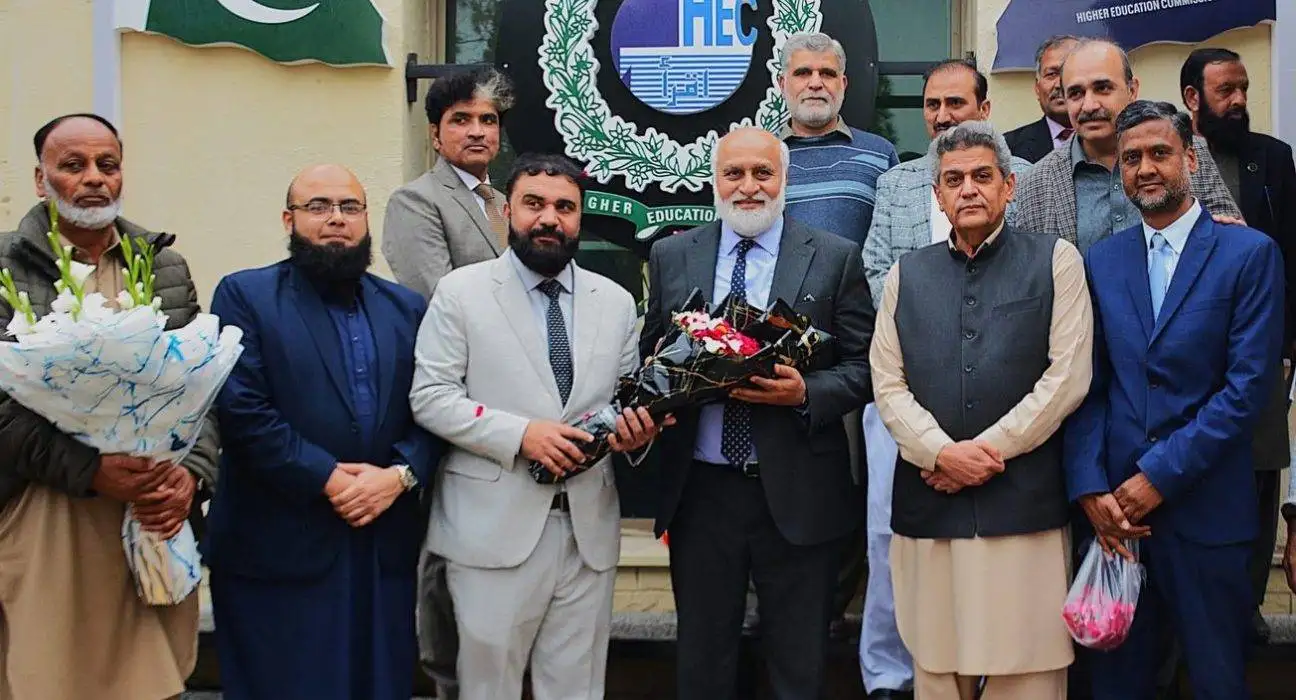
After a six-month vacancy, the Higher Education Commission (HEC) formally welcomed its new chairman on Friday, with Prof Dr Niaz Ahmad Akhtar (Sitara-i-Imtiaz) assuming office and unveiling an ambitious agenda aimed at revitalising Pakistan’s higher education sector.
The new chairman steps in at a time of mounting challenges for universities, including chronic funding shortages, governance concerns within HEC, and unresolved issues faced by faculty and university administrations. Insiders note that addressing these pressures will be central to Dr Akhtar’s tenure.
A former vice chancellor of Quaid-i-Azam University (QAU), Dr Akhtar brings extensive on-ground experience of the sector’s constraints. On his first day in office, he reportedly raised the issue of acute funding shortfalls for public universities with the federal government.
“You will see drastic and visible changes in the higher education sector,” Dr Akhtar told Dawn after taking charge. Emphasising government backing, he said the federal government was keen to strengthen HEC and universities, adding that reforms would focus on better equipping teachers and students. He also announced plans to propose the establishment of a Graduate Employment Cell at the upcoming HEC Commission meeting.
Outlining his reform roadmap, Dr Akhtar spoke of launching a dedicated research fund, strengthening quality assurance mechanisms, modernising curricula, accelerating digitisation, and expanding international collaboration, particularly with European and United States universities. He stressed the need for industry-oriented academic programmes and enhanced faculty development to help build a knowledge-based economy.
Responding to questions about recent governance issues and internal disputes within HEC, the chairman assured that institutional order and effective service delivery would be ensured. “Our main focus is to help universities produce quality graduates for the country’s progress,” he said.
On his transition from QAU, Dr Akhtar indicated that the federal government and the Ministry of Education would appoint an interim head from within the university until a permanent vice chancellor is selected.
Funding, however, remains the most pressing concern. For the fiscal year 2025-26, development funding for higher education has been reduced to Rs39.4 billion from Rs66.3 billion in the previous year, while recurring grants have largely remained stagnant despite rising operational costs. Dr Akhtar said securing adequate funding would be his top priority in the upcoming federal budget, recalling his earlier success in obtaining a special Rs2 billion grant for QAU.
Related: HEC and Julich Eye Landmark Scientific Collaboration
According to an HEC press release, Dr Akhtar was received at the HEC Secretariat by Executive Director Prof Dr Zia Ul Haq and senior officers. With over 35 years of experience in academia and research, he is regarded as the country’s most senior vice chancellor, having led six higher education institutions over 16 years. A distinguished scholar with a PhD in Chemical Engineering from the University of Leeds, UK, Dr Akhtar has authored numerous research publications and supervised several PhD candidates.