

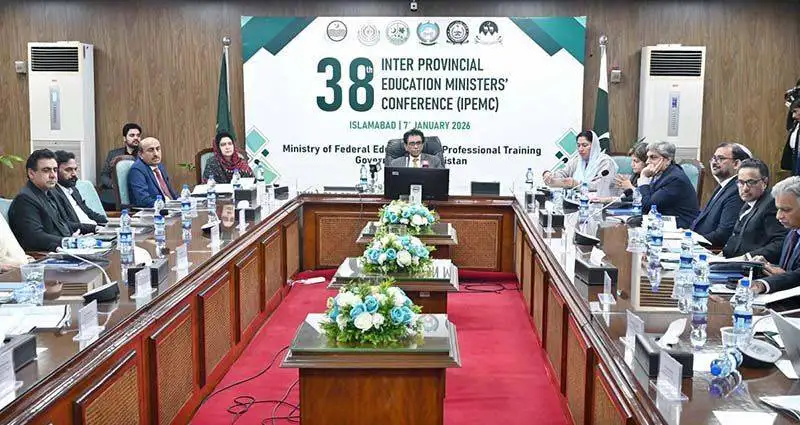
Federal and provincial governments have forged a rare consensus to confront Pakistan’s deepening out-of-school children crisis, approving a comprehensive National Education Action Plan aimed at reversing one of the country’s most pressing social challenges. The landmark decision was taken at the 38th Inter-Provincial Education Ministers Conference (IPEMC), chaired by the Minister of Federal Education and Professional Training (MoFEPT) Dr Khalid Maqbool Siddiqui.
The scale of the challenge is stark. According to UN agencies, more than 25 million children in Pakistan are currently out of school, placing the country among those with the highest numbers globally. Economic hardship, climate-related disruptions, population pressures, and long-standing underinvestment in education have collectively worsened the situation.
Demonstrating unprecedented national coordination, the federal government, all four provinces, Gilgit-Baltistan, and Azad Jammu and Kashmir unanimously endorsed the five-year roadmap. The conference also approved a federal Challenge Fund to financially support provincial initiatives focused on bringing out-of-school children back into classrooms.
Provincial education ministers shared concrete steps already underway. Punjab announced plans to outsource 10,000 schools to improve management and access. Sindh confirmed the merit-based recruitment of 93,000 teachers to strengthen its education workforce. Balochistan reported the reopening of 3,200 schools, resulting in the return of around 140,000 children to education. Khyber Pakhtunkhwa cited a six percent rise in enrolment alongside the recruitment of 10,000 teachers. Azad Jammu and Kashmir allocated Rs7 billion for the construction of 10,000 new classrooms, while Gilgit-Baltistan outlined funding for out-of-school children and the expansion of its school meal programme to boost attendance.
Federal Secretary Education Nadeem Mahbub said all approved initiatives would be placed before the Prime Minister’s Education Emergency Task Force for final ratification. He urged provinces to participate in federal board reforms and align matriculation and technical education programmes with international standards to improve quality and global competitiveness.
Developed over six months of extensive stakeholder consultations, the National Education Action Plan seeks a systematic reduction in the out-of-school population. The conference also cleared measures related to technical and vocational education, the establishment of a national education data regime, modern curriculum reforms, and a character-building framework.
Related: Pakistan Railways Schools Raise Tuition Fees
Concluding the conference, Dr Khalid Maqbool Siddiqui described the agreement as a milestone in national harmony, stressing that sustained collaboration between the centre and provinces would be essential to meeting global education benchmarks. He highlighted informal education, outreach to remote and underserved regions, and the mainstreaming of madrasa students as key priorities in the reform agenda.