

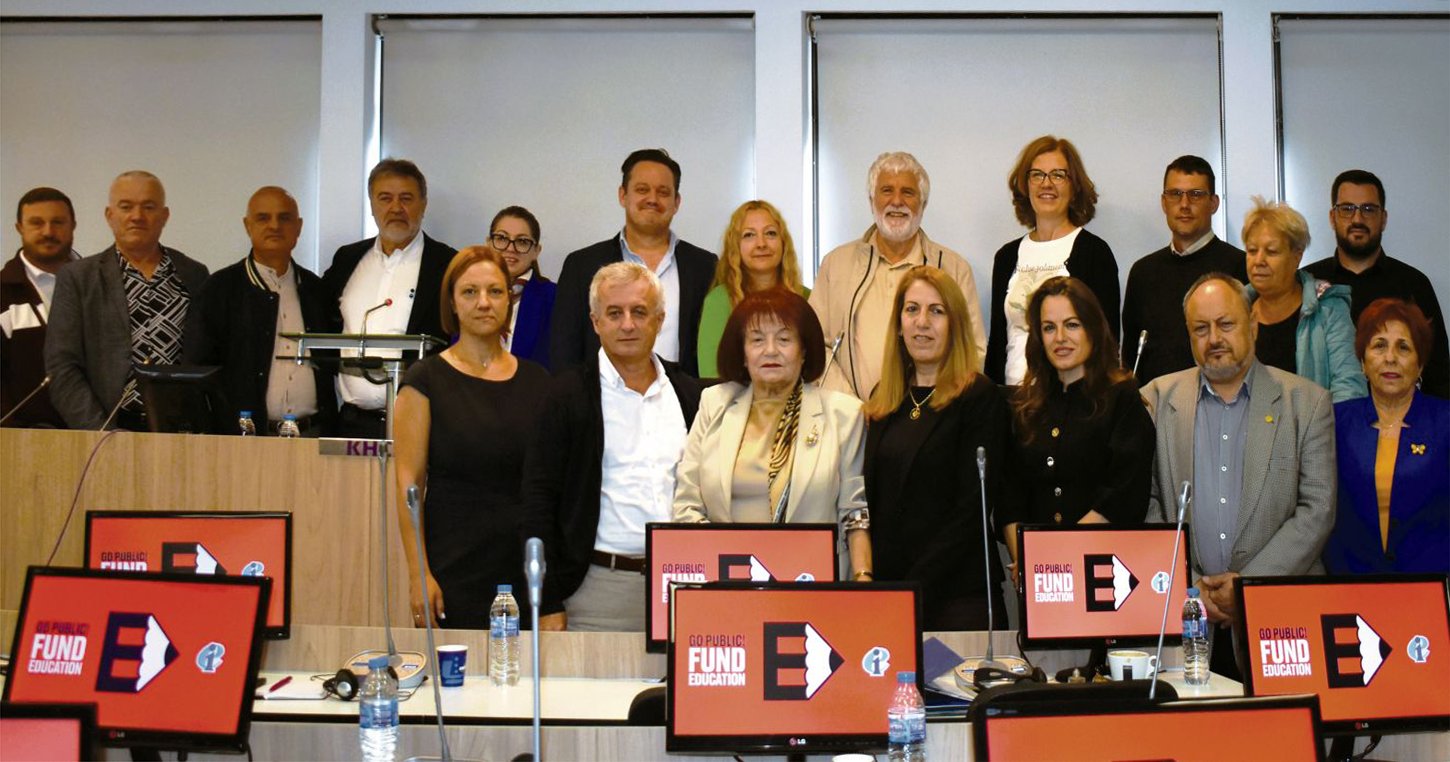
Education union leaders from across Southeast Europe have joined forces in Sofia, Bulgaria, to demand greater public investment in education and stronger measures to make teaching a more attractive and sustainable profession.
The three-day strategic forum, hosted by the Bulgarian Teachers’ Union under Education International’s “Go Public! Fund Education” campaign, brought together union representatives from Albania, Bosnia and Herzegovina, Bulgaria, Kosovo and Slovenia, along with education authorities and representatives of Education International and the European Trade Union Committee for Education (ETUCE).
The discussions focused on teacher shortages, workloads, salaries, employment security, professional development and the need for stronger social dialogue between governments and education workers. Participants argued that education should be treated as a long-term public investment rather than simply another item of government expenditure.
The meeting comes as teacher shortages and an ageing workforce remain major concerns across Europe. Eurostat reported that 40.4% of teachers in EU primary and secondary schools were aged 50 or older in 2024, while only 8% were under 30. The European Commission has also identified administrative workload, classroom challenges and difficulties attracting and retaining teachers as significant pressures on the profession.
Bulgaria faces several of these challenges itself, particularly shortages in science, mathematics and other STEM-related subjects. Earlier European Commission analysis found that teacher shortages were especially pronounced in some subjects and rural areas, while many graduates of teacher-training programmes did not enter the profession and a significant proportion of young teachers left after their first year.
Yanka Takeva, President of the Bulgarian Teachers’ Union, stressed the importance of recognising education as a strategic investment capable of responding to technological, demographic and social changes.
The forum also examined the implementation of recommendations from the United Nations High-Level Panel on the Teaching Profession. Participants discussed how governments can improve teacher preparation, professional development, working conditions and career prospects while giving educators a stronger voice in education policymaking.
The Bulgarian experience was highlighted as an example of how collective bargaining and social dialogue can contribute to improvements in teacher pay, professional development and employment security. However, union representatives acknowledged that the country still faces difficulties attracting younger teachers and addressing shortages in key subjects.
Jelmer Evers, European Director of ETUCE, said the Sofia gathering demonstrated the importance of strategic planning and cooperation among education unions. He also highlighted the Bulgarian Teachers’ Union as an example of effective union organisation and constructive social dialogue.
Angelo Gavrielatos, manager of Education International’s Go Public! Fund Education campaign, said the discussions reflected a global education staffing crisis. Figures presented at the meeting indicate that education systems worldwide face a shortage of about 44 million teachers, including around 4.8 million across Europe and North America.
Gavrielatos said the response requires sustained advocacy and stronger education unions capable of influencing public policy. Education International’s campaign calls for governments to fully fund public education while ensuring fair salaries, manageable workloads, secure employment, labour rights and respect for teachers’ professional expertise.
The Sofia forum concluded with a commitment to strengthen cooperation among education unions across Southeast Europe and build collective support for greater investment in teachers and public education. The gathering was part of a wider series of Education International regional initiatives aimed at turning union advocacy into stronger education policies and increased public investment.
