

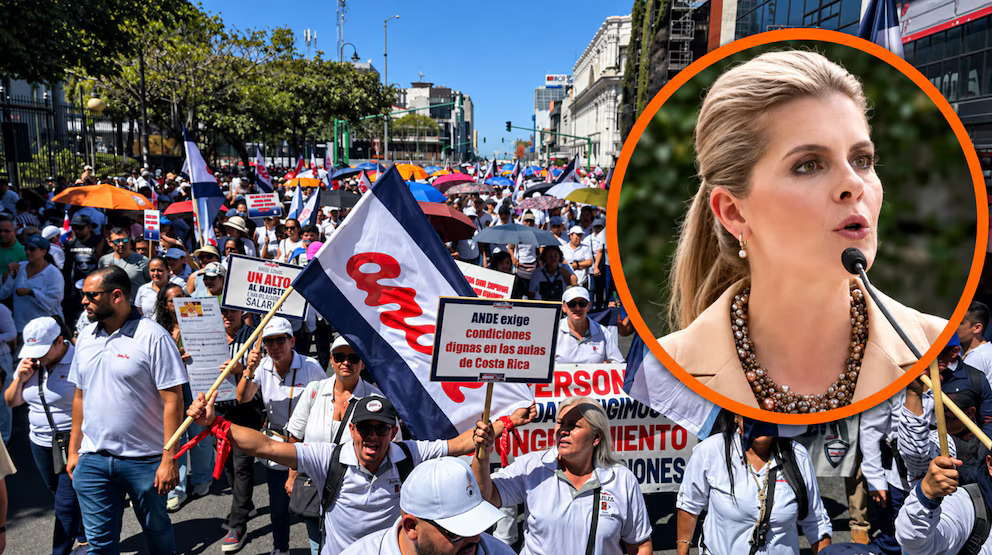
Thousands of teachers, university staff and students took to the streets of Costa Rica’s capital on Wednesday, November 11, in a nationwide protest against government cuts to education funding, demanding greater investment in public education and protection of teachers’ rights.
Public education unions organised a one-day strike and a massive demonstration in downtown San José, bringing together educators, students and representatives of public universities to challenge the government’s proposed 2027 education budget.
The demonstration began at La Merced Park and moved along Avenida Segunda towards Plaza de la Democracia, outside the Legislative Assembly, where protesters called on lawmakers to reconsider the proposed reductions in education spending.
At the centre of the dispute is the government’s decision to allocate 4.9% of the country’s gross domestic product (GDP) to education in 2027, significantly below the 8% target established in Costa Rica’s Constitution. The proposed allocation also represents a decline of 0.7% in nominal terms compared with the previous year’s budget, according to the Spanish news agency EFE.
Teachers’ unions argue that inadequate funding threatens the quality of public education and limits students’ access to essential educational services. They are demanding that the government move towards fulfilling its constitutional commitment to allocate 8% of GDP to the education sector.
“We are here to defend our rights, but also the rights of students to receive quality education, which requires an adequate budget to meet all their needs,” educator Carolina Villegas told EFE during the demonstration.
She urged the government to recognise that investing in education means investing in the country’s future.
Beyond budget reductions, protesters raised concerns about unpaid salary adjustments, frozen wages, teachers’ pension obligations and outstanding government payments to the national teachers’ pension system.
Public universities also joined the demonstration, opposing a proposed reduction of 8.048 billion Costa Rican colones in funding that the government had previously committed to returning to higher education institutions. University representatives warned that funding cuts could affect scholarships, student support programmes and educational opportunities, particularly for young people from rural communities.
The protests brought together major education organisations, including the National Association of Educators (ANDE), the Costa Rican Teachers’ Union (SEC) and the Association of Secondary Education Teachers (APSE), alongside university unions and student groups.
Opposition lawmakers also met demonstrators outside the Legislative Assembly and expressed support for their demands, as the proposed 2027 national budget remained under parliamentary discussion.
However, the government strongly criticised the strike. Education Minister Leonardo Sánchez said the demonstration was politically motivated and warned that the government could seek a judicial declaration to establish the strike as illegal.
President Laura Fernández also announced that salaries would be deducted from public employees who participated in the protest, further escalating tensions between the government and education unions.
The government has defended its budget decisions amid mounting public debt, economic pressures and competing demands for public spending.
The proposed education budget has become a major point of contention in Costa Rica, where teachers and university representatives warn that continued reductions could undermine public education, weaken student support systems and restrict access to higher education.
Related: Italy Evacuates 300 Schools After Bomb Threats
The November 11 demonstration reflects growing tensions over the future of public education financing in the country, with education unions insisting that adequate investment is essential to protect students’ opportunities and maintain educational standards.
Editorial note: The 8% figure is the constitutional funding target, not the current allocation. The proposed 2027 allocation is 4.9% of GDP.
