

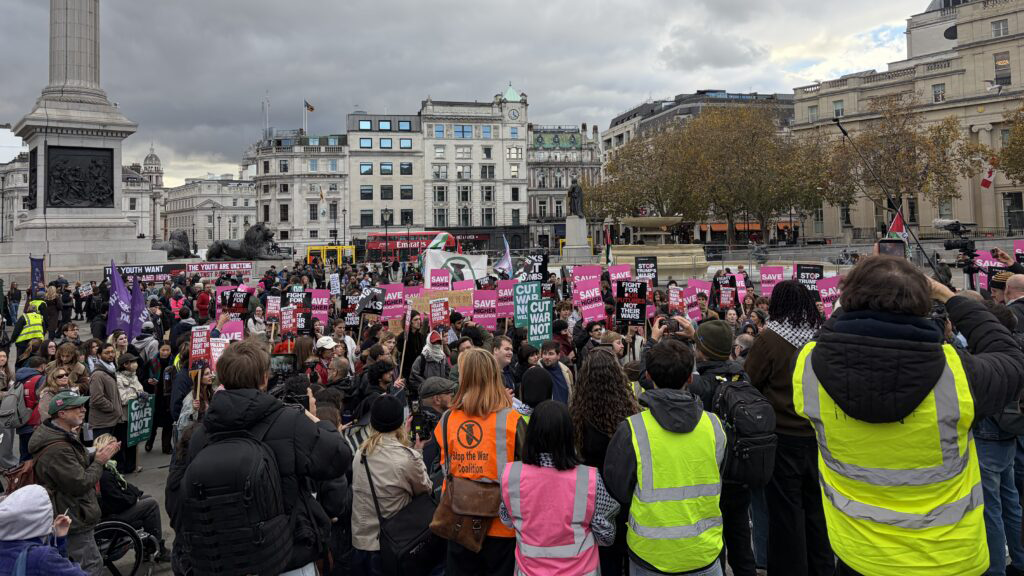
Thousands of university students and staff across the United Kingdom have joined nationwide protests demanding increased higher education funding, protection of university jobs and better career opportunities for graduates, highlighting growing concerns over the future of the country’s education sector.
The demonstrations took place on November 20 as part of a coordinated national day of action organised by university staff unions and student groups. The protests brought together students, lecturers and university employees who say years of financial pressure, job cuts and rising living costs are undermining higher education.
Thousands of students left their universities and marched through central London, joining a rally that began at the London School of Economics (LSE) and continued towards Trafalgar Square. Demonstrators called for greater investment in universities, improved employment prospects for graduates and stronger financial support for students.
The student demonstrations coincided with a nationwide campaign organised by the University and College Union (UCU), which mobilised more than 120 branches across the UK to hold rallies and protests on university campuses.
The movement was inspired partly by student demonstrations in France and other European countries, where young people have increasingly taken to the streets over education funding, economic pressures and concerns about their future.
During the London march, protesters raised concerns about the government’s spending priorities, calling for more investment in education, employment and public services rather than military expenditure. Some demonstrators also highlighted the impact of international conflicts and demanded an end to violence in the Middle East.
The participation of university staff alongside students gave the demonstrations a broader focus, connecting concerns about educational quality with lecturers’ working conditions, university finances and graduate employment.
Jo Grady, general secretary of the University and College Union, told protesters that staff and students needed to stand together to defend education. She called for free education, better wages and greater public investment in universities.
The demonstrations also highlighted the financial difficulties facing individual institutions. Students from Goldsmiths, University of London, carried a symbolic coffin bearing the university’s name to draw attention to funding cuts and the prolonged industrial dispute at the institution.
Beyond London, university campuses across the country organised rallies as part of the coordinated action. The participating unions warned that financial pressures were contributing to job losses and threatening the sustainability of higher education institutions.
However, union representatives differed over the next steps. While some described the protests as an important starting point for a stronger national campaign, others argued that a single day of demonstrations would not be enough to address the sector’s problems.
Jamie Woodcock, an executive branch member of the UCU at King’s College London, called for a more coordinated national strategy, arguing that protests should be accompanied by sustained action and stronger pressure on the government.
The UCU is considering further nationally coordinated activities in the new year under its newly launched campaign, “Education. It’s ours”, as unions seek to build wider support for increased investment and protection of university jobs.
The November 20 demonstrations also formed part of a wider wave of youth-led protests across Europe, reflecting growing frustration among students over the affordability, accessibility and long-term value of education.
Related: Italian Students Rise Against Education Cuts and Economic Crisis
The protests have placed higher education funding and graduate employment back at the centre of the public debate, with students and university employees warning that continued financial pressures could undermine educational opportunities and the future of universities.
