

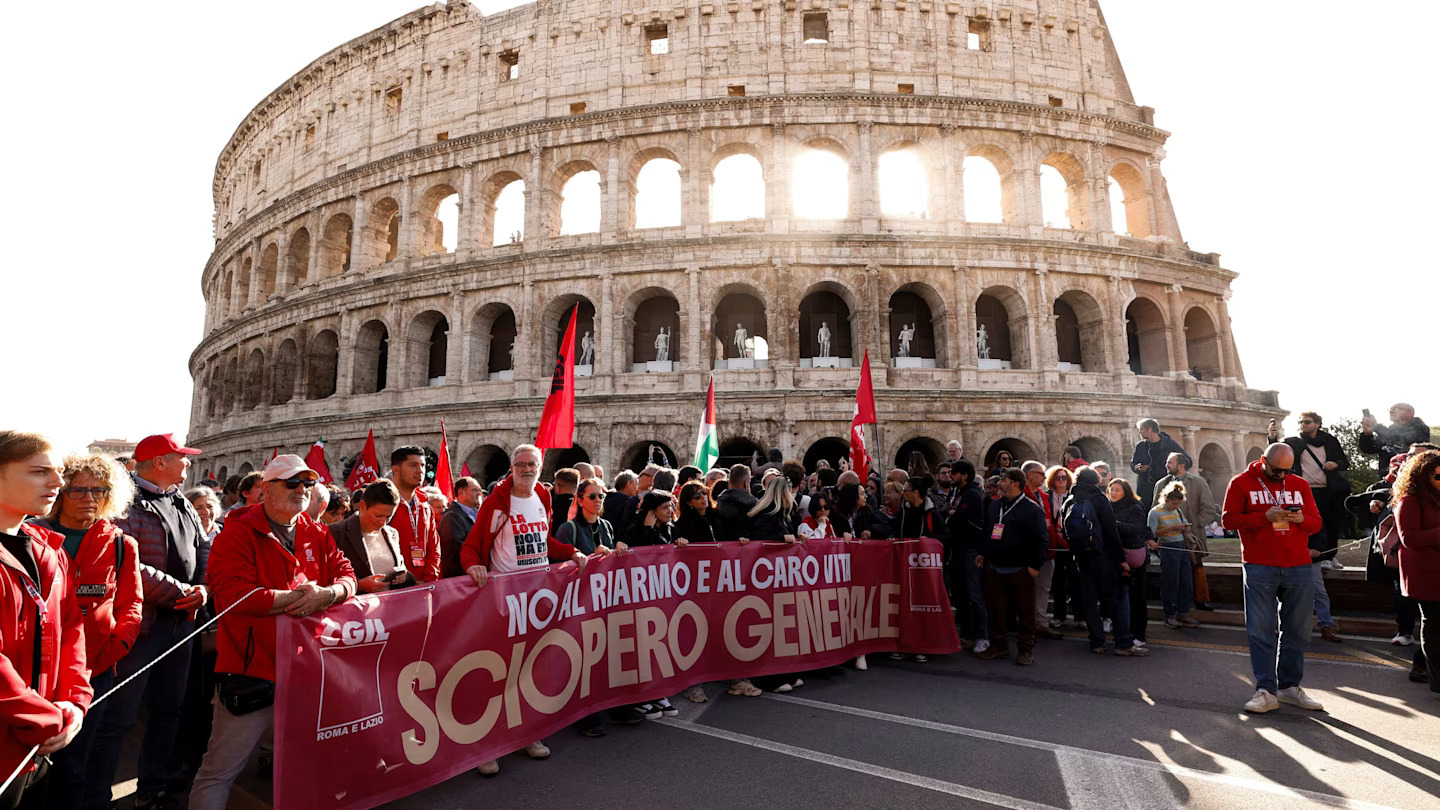
Tens of thousands of workers and students took to the streets across Italy on Friday, November 20, staging nationwide demonstrations and a 24-hour general strike against rising living costs, stagnant wages and declining public services. The protests also highlighted growing concerns over education funding, deteriorating school conditions and the government’s spending priorities.
Organised primarily by Italy’s largest trade union, the General Confederation of Italian Labour (CGIL), the demonstrations took place in more than 100 cities, including Rome, Milan, Naples, Turin, Bologna, Genoa and Bari. Student groups also joined the nationwide mobilisation, making education and young people’s economic prospects central issues in the protests.
CGIL leader Maurizio Landini claimed that more than one million people participated in demonstrations across the country, although an independent official estimate had not been released. He urged the government to listen to public concerns, warning that the union would continue its mobilisation if authorities failed to respond to protesters’ demands.
Students joined workers in criticising the government’s proposed 2027 budget, arguing that insufficient investment in education, healthcare and social protection was worsening conditions for ordinary families and young people. Demonstrators also opposed increased military spending, calling instead for greater investment in public services and opportunities for future generations.
Education emerged as a significant concern, with protesters highlighting underfunded schools, deteriorating educational infrastructure and the need for stronger public investment. Student organisations also raised concerns about the rising cost of living, unaffordable housing and the financial pressures facing young people pursuing higher education.
The demonstrations were also directed against Prime Minister Giorgia Meloni’s proposed €26 billion budget for 2027. CGIL has argued that the government’s economic plans do not adequately address declining purchasing power, workers’ financial difficulties and the growing pressure on public services.
The union is demanding higher wages and pensions, renewed employment contracts, stronger protection against inflation, improved workplace conditions and increased funding for healthcare and education. It has also called for measures to address housing affordability and prevent a further increase in the retirement age.
The general strike affected public and private sectors, including schools, healthcare facilities and local public transport, resulting in service disruptions in several cities. Air and rail services were excluded from the main strike, although a separate railway strike was scheduled to begin later on Friday.
Italy’s demonstrations formed part of a wider wave of student and youth mobilisation across Europe on November 20. Young people in Germany, France, Britain, Austria, Belgium and other countries also participated in protests demanding better education systems, stronger public services and action on the rising cost of living.
Related: Climate Education Takes Centre Stage at COP31 in Türkiye
The demonstrations reflect growing frustration among Europe’s younger generation over economic insecurity, education funding and government spending priorities, with students increasingly linking the quality of education to broader questions of employment, housing and their future opportunities.
