

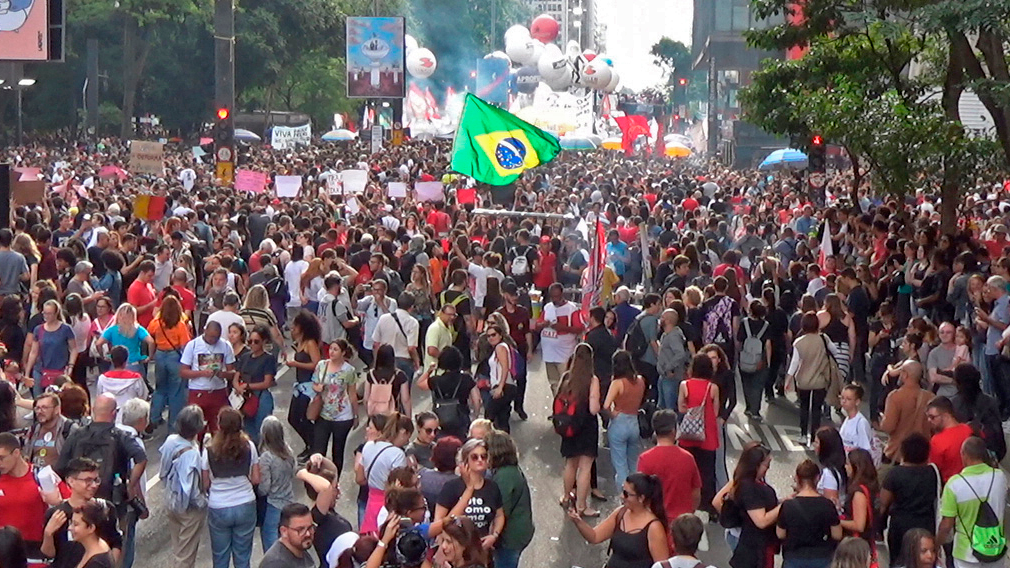
Hundreds of students and activists took to the streets in Brazil on Tuesday, November 17, protesting against the fiscal adjustment plan proposed by President Luiz Inácio Lula da Silva’s government, warning that the measures could threaten public spending on education, healthcare and social welfare.
The demonstrations, organised by the National Union of Students (UNE), were held in several Brazilian cities, with São Paulo emerging as a major centre of mobilisation. Protesters gathered along Avenida Brigadeiro Faria Lima, one of the country’s main financial districts, to challenge what they described as growing influence of financial markets over government economic policies.
In São Paulo, demonstrators occupied several lanes of the busy avenue, disrupting traffic as they marched with banners, flags and slogans against spending restrictions. Police monitored the gathering and later used tear gas to clear parts of the road.
Students argued that reducing public expenditure should not come at the expense of essential services, particularly education and healthcare. They warned that restrictions on government spending could limit investment in public universities, schools and social protection programmes.
Bianca Borges, president of the National Union of Students, said the demonstration was directed against pressure from financial markets for fiscal adjustments that could undermine social investment.
She argued that Brazil’s economic challenges should not be addressed by reducing spending on healthcare and education, but through measures targeting wealthier sections of society, including higher taxation on the richest.
Student demonstrator Renato Ortega also criticised the proposed approach, arguing that fiscal adjustment plans repeatedly place the burden on social programmes, education and healthcare while protecting the interests of wealthy groups and financial institutions.
The protests highlighted growing disagreements over the government’s economic direction, including among organisations and political groups that had supported Lula’s election campaign.
The proposed fiscal adjustment package aims to control public expenditure, strengthen government finances and contain the country’s growing debt. However, its opponents fear that limiting spending growth could weaken the government’s ability to expand essential public services.
The Senate had approved the main text of the fiscal adjustment proposal, but voting on amendments was postponed until November 18. The legislation is expected to undergo further consideration in Brazil’s Congress before its provisions can take effect.
The demonstrations have brought students’ concerns about the future of public education and social investment into the wider debate over Brazil’s economic priorities.
Reports indicated that the São Paulo demonstration attracted several hundred participants, while protests were also organised in other parts of the country, including Rio de Janeiro. The mobilisation reflected wider concerns among student organisations about the long-term impact of fiscal restrictions on Brazil’s education system and public services.
The proposed measures include restrictions on the annual growth of federal government spending, changes to minimum public health investment requirements, reductions in corporate tax incentives and measures targeting excessive public-sector salaries. The package is estimated to affect the 2027 federal budget by between 45.1 billion and 56.1 billion Brazilian reais.
Related: Serbian Students Enter Parliament as New Lawmakers
The protest has added pressure on the government as lawmakers continue debating how to balance fiscal discipline with investment in public services and social development.
