

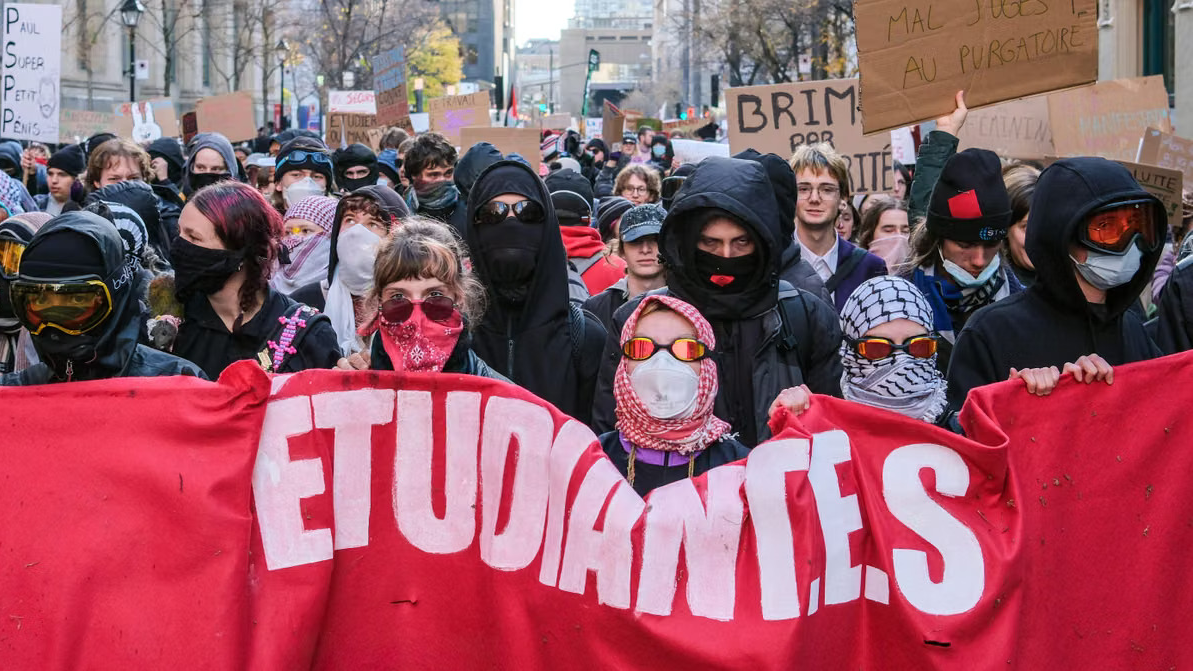
Thousands of students have taken to the streets across Quebec, Canada, in a growing protest movement against rising living costs, student poverty, mounting debt and deteriorating conditions in higher education, drawing inspiration from recent student mobilisations in France.
The movement reached a major demonstration on November 13, when thousands of students marched through downtown Montréal following five days of strikes at colleges and universities across the province. Organised by the Coalition de résistance pour l’unité étudiante syndicale (CRUES), the mobilisation has brought renewed attention to the financial difficulties facing young people and the growing pressure on Quebec’s higher education system.
The coalition estimates that approximately 100,000 young people, representing nearly a quarter of Quebec’s student population, have participated in the wider protest movement. Separate reports put the number of students on strike during the week at more than 60,000, with additional student associations joining individual strike actions.
Students say the rising cost of living and an increasingly unaffordable housing market are making it difficult to continue their education without taking on significant debt or relying on food banks. Many are also struggling with financial assistance programmes that they believe fail to reflect the actual cost of studying and living independently.
One of the major concerns is the widespread practice of unpaid internships, including placements that are compulsory for completing certain academic programmes. Students argue that having to pay tuition fees while undertaking unpaid professional training places an additional financial burden on those already struggling to make ends meet.
The CRUES is demanding increased student grants, mandatory payment for internships and substantial new investment in colleges and universities. It is also calling for reforms to financial assistance programmes to ensure that students from lower-income backgrounds receive adequate support.
The movement has also highlighted the deteriorating condition of educational infrastructure, shortages of teaching staff and insufficient institutional funding. Students argue that years of underinvestment have affected both the quality of education and the learning environment.
The protests have attracted support from teachers’ unions and education-sector workers, with several educators joining demonstrations to express solidarity with students. The mobilisation has also revived memories of Québec’s 2012 Maple Spring, when a major student movement opposed university tuition increases and became one of the province’s most significant social protests.
However, Friday’s demonstration in Montréal turned tense after clashes between protesters and police. Authorities used tear gas to disperse parts of the crowd, while several buildings and vehicles sustained damage. Police confirmed that three demonstrators were arrested.
The protests come as a new Parti Québécois government takes office in the province, increasing pressure on provincial authorities to address the students’ demands. Organisers have warned that demonstrations and strike actions could continue until the government responds to their concerns.
Related: Students Reject Elitist Education Policies in Belgium
What began as a series of campus-level protests has developed into a broader movement challenging the affordability of higher education and the financial insecurity experienced by young people. With students drawing inspiration from France and recalling Québec’s own history of mass student mobilisation, the latest demonstrations could signal a renewed period of student activism in Canada.
