

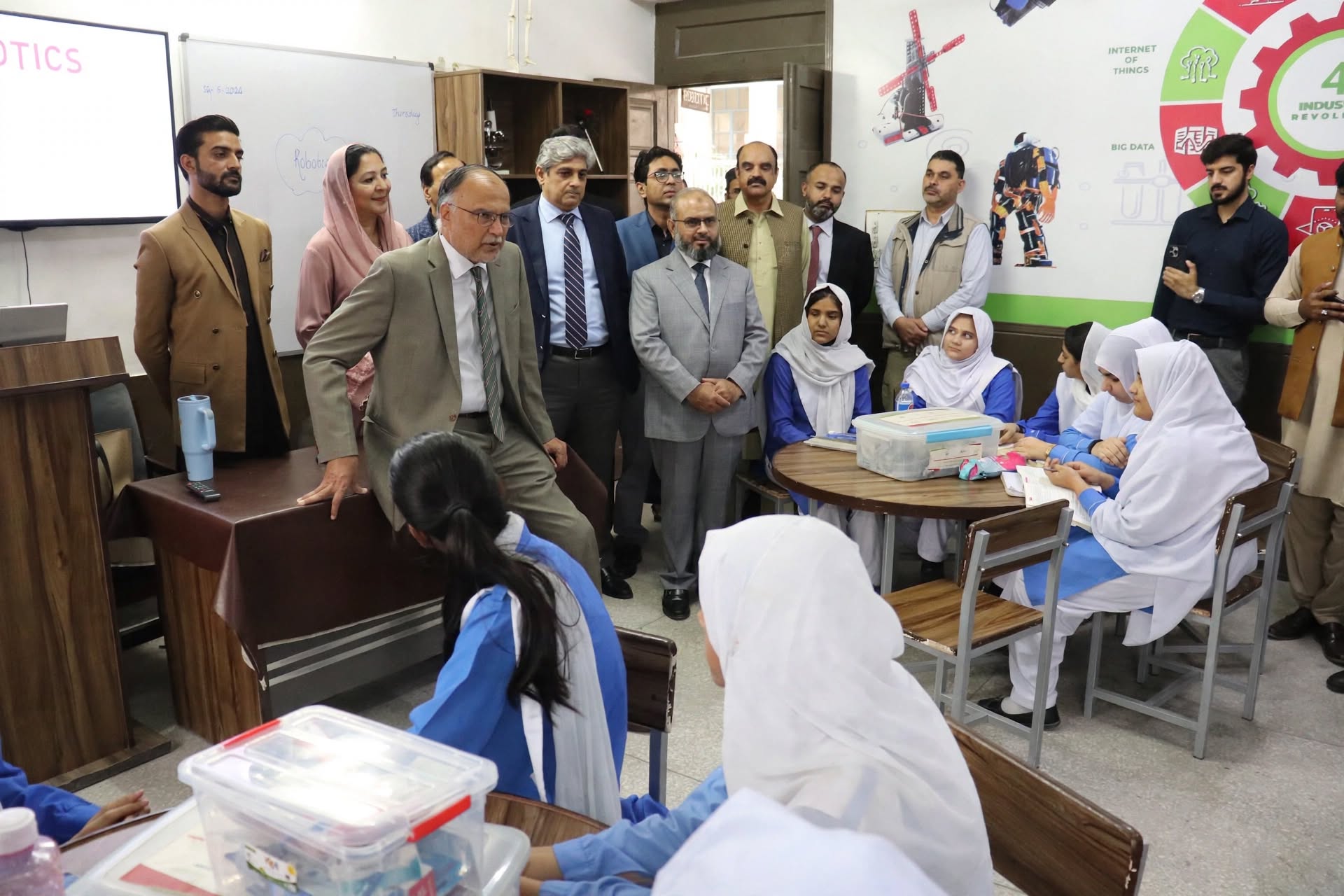
The government is working to transform Islamabad’s education system into a model of quality, equity and innovation that could eventually be replicated across other parts of Pakistan, Federal Minister for Planning, Development and Special Initiatives Ahsan Iqbal has said.
Speaking during a visit to Islamabad Model College for Girls (IMCG) Golra Girls School under the Islamabad Capital Territory (ICT) Education Reforms initiative, the minister said the government aimed to establish an education system that provides every child with equal opportunities to access quality education.
Ahsan Iqbal said the reforms were intended to transform educational institutions into high-performing centres capable of delivering measurable improvements in teaching standards and student learning outcomes. He clarified that the initiative was not about removing anyone from the existing system but improving its overall performance.
Emphasising the need to modernise education, the minister said Pakistan must move beyond traditional rote learning and develop a system that encourages critical thinking, creativity, research, problem-solving and independent reasoning.
He observed that the country’s conventional education model, influenced by colonial-era practices, had placed excessive emphasis on memorisation rather than intellectual development and independent thinking.
The minister also highlighted the importance of early childhood education, saying the first five to seven years of a child’s life were particularly important for developing intellectual and creative abilities. He stressed that these capabilities required supportive learning environments at home, in schools and throughout society.
Calling for reforms across the entire education system, from early childhood education to colleges and universities, Ahsan Iqbal said teachers must move beyond simply delivering curricula and preparing students for examinations.
Instead, classrooms should become centres of inquiry, research and discovery, where students are encouraged to ask questions, develop reading habits, explore ideas and learn through observation and practical experiences.
He further stressed that education should not be limited to obtaining academic degrees but should foster lifelong learning, research and continuous intellectual growth.
The minister said the world was undergoing an unprecedented knowledge revolution in which national development would increasingly depend on intellectual capabilities, creativity and the ability to generate new knowledge.
He added that Pakistan should aspire not merely to benefit from knowledge produced elsewhere but also to become a contributor to global research, innovation and intellectual progress.
The latest remarks come as the government advances a broader reform programme for Islamabad’s education sector under the direction of Prime Minister Shehbaz Sharif.
Earlier, on November 6, Ahsan Iqbal reviewed a 60-day reform roadmap and directed officials to develop proposals for restructuring the sector, including the establishment of an autonomous education authority for Islamabad. The proposed authority would have an independent-majority Board of Governors and a chief executive selected on merit.
The reform framework covers institutional governance, school infrastructure, financing, teacher recruitment and professional development, curriculum, classroom teaching, student assessment, accountability and equal access to education.
According to the Planning Commission, the Federal Directorate of Education (FDE) network comprises 432 educational institutions in Islamabad, alongside a wider network of private, informal and special education institutions. The government has also identified infrastructure gaps and weaker learning outcomes in rural schools as key areas requiring attention.
Ahsan Iqbal said policymakers were visiting educational institutions to understand ground realities, identify challenges and consult teachers and education personnel. He invited education professionals to share practical recommendations, saying their experience would be essential to making the reforms effective and responsive to students’ needs.
Related: Islamabad Moves Against Unregistered Schools, Violations
The success of the initiative will ultimately depend on whether the proposed reforms translate into better classroom facilities, stronger teaching standards and more equitable learning opportunities for students across Islamabad.
