

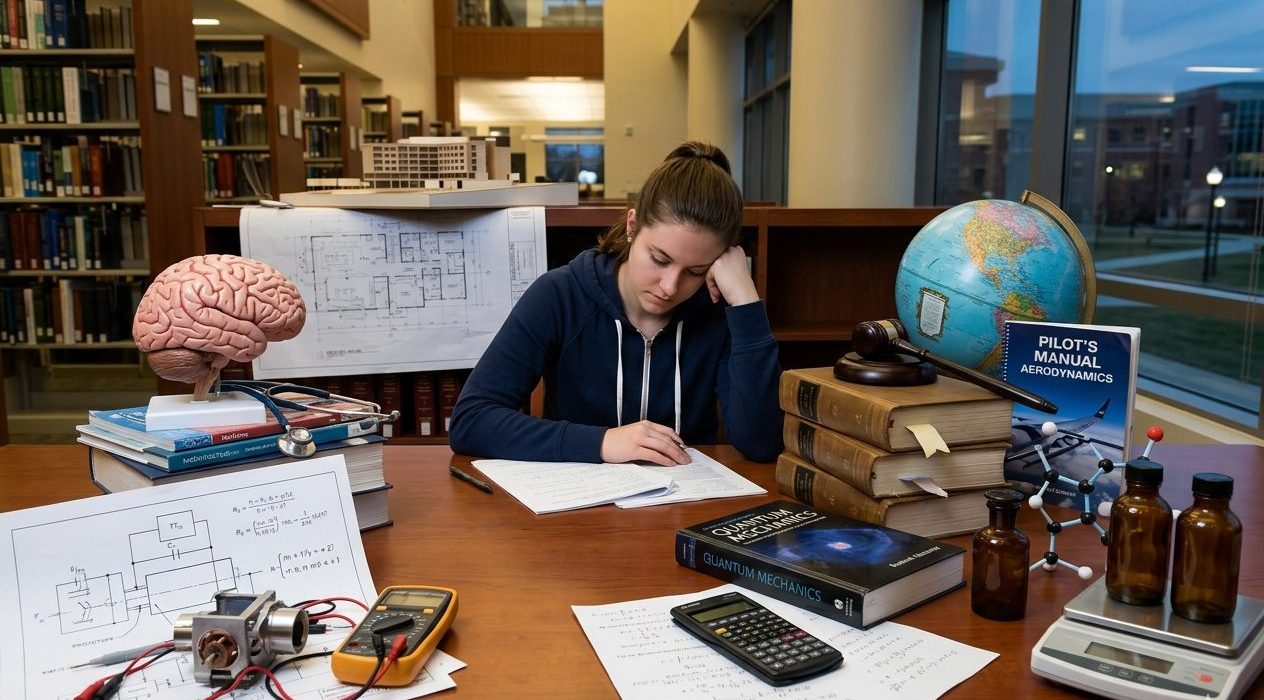
When students think about higher education, one common question often arises: what are the hardest degrees in the world? These programs are known for their intense workload, complex subjects, and high expectations. The discussion around toughest degrees is not just about difficulty, but also about discipline, intelligence, and long-term commitment required to succeed.
Many learners underestimate what makes these programs so demanding, which is why the topic of hardest degrees in the world remains highly relevant for students planning their academic future. Understanding what qualifies as the hardest degrees in the world helps students prepare mentally and academically before choosing a career path. These degrees often require years of dedication, strong analytical skills, and the ability to handle pressure in both theoretical and practical environments.
Engineering
Engineering is widely considered one of the most challenging academic paths among the hardest degrees in the world. It involves advanced mathematics, physics, and technical problem-solving that pushes students to their limits. Students studying engineering often face long study hours and complex assignments, which is why it is frequently listed among the toughest degrees. From civil to electrical and mechanical engineering, each specialization demands precision and logical thinking. Another reason engineering falls under the hardest degrees in the world is the practical application of theory. Students must not only understand concepts but also apply them in real-world projects, which increases pressure significantly.
Medicine
Medicine is yet another one of the fields that consistently appears in discussions about the hardest degrees in the world. Medical students must memorize vast amounts of information related to human anatomy, diseases, and treatments. The journey to becoming a doctor is long and mentally exhausting, making it one of the toughest degrees. Students spend years in classrooms, laboratories, and hospitals before they are even allowed to practice independently. What makes medicine one of the hardest degrees in the world is the responsibility involved. A small mistake in this field can have serious consequences, which adds emotional and psychological pressure on students.
Law
Law is also widely recognized as one of the hardest degrees in the world due to its heavy reading requirements and complex legal systems. Students must understand case laws, legal principles, and constantly changing regulations. Many students find law among the toughest degrees because it demands excellent memory skills and critical thinking abilities. Every case must be analyzed in detail, leaving no room for error. The competitive nature of the profession further strengthens its position among the hardest degrees in the world, as students must not only study hard but also develop strong argumentative and communication skills.
Architecture
Architecture also combines creativity with technical knowledge, making it one of the hardest degrees in the world. Students must master design principles, engineering basics, and software tools simultaneously. It is considered one of the toughest degrees because of the long hours required for design projects and model making. Students often work late into the night to complete assignments. Architecture also stands out among the hardest degrees in the world because it requires both artistic vision and structural accuracy, a balance that is difficult to achieve consistently.
Mathematics and Physics
Mathematics and physics are often grouped together when discussing the hardest degrees in the world. These subjects involve abstract theories, complex formulas, and deep conceptual understanding. Students pursuing these fields often struggle with problem-solving at an advanced level, which is why they are part of the toughest degrees. The concepts are not only difficult to learn but also challenging to apply. Another reason they are considered among the hardest degrees in the world is the level of logical reasoning required. A single misunderstanding can lead to completely incorrect results.
Pharmacy and Aviation
Pharmacy and aviation are also included in the list of hardest degrees in the world due to their technical and safety-critical nature. Pharmacy students must understand chemistry, drug interactions, and patient safety in detail. This field is counted among the toughest degrees because precision is essential. Even a small miscalculation in dosage or formulation can be dangerous. Aviation, on the other hand, is part of the hardest degrees in the world because it requires mastery of aerodynamics, navigation, and real-time decision-making under pressure. Pilots undergo rigorous training and examinations before they are certified.
Why These Degrees Are So Challenging?
The main reason these programs are considered the toughest is the combination of theory, practice, and responsibility. Students are not only required to learn but also to perform under pressure. Another key factor is time commitment. Most of these programs demand long study hours, practical training, and continuous assessment throughout the academic year. Emotional resilience also plays a major role. Students must stay focused despite stress, competition, and high expectations.
Other than Hardest Degrees in the World, you can also explore Degrees With the Lowest Unemployment Rate
Thus, choosing a difficult academic path is not just about intelligence but also about passion and determination. The programs discussed above require dedication, discipline, and strong mental endurance. While they may be challenging, they also offer rewarding career opportunities and global recognition for those who succeed.
FAQs
What are considered the toughest degrees?
Degrees like medicine, engineering, law, architecture, mathematics, and physics are commonly ranked among the hardest due to their complexity and workload.
Why are some degrees harder than others?
Some degrees are harder because they require advanced technical knowledge, long study hours, and the ability to apply concepts in real-life situations.
Can an average student succeed in difficult degrees?
Yes, with consistent effort, time management, and dedication, even average students can succeed in challenging academic programs.
