

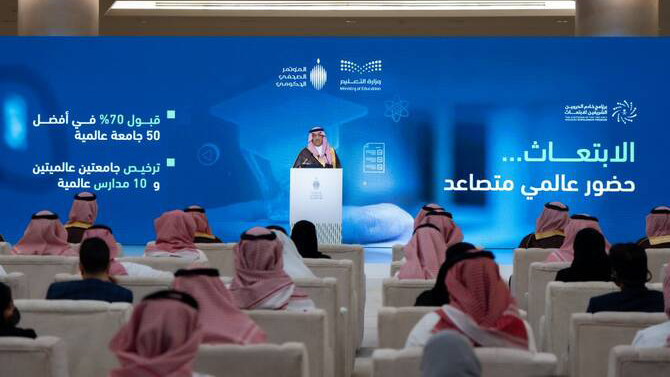
Saudi Arabia is introducing major reforms to its education system ahead of the new academic year, including a ban on teachers teaching subjects outside their areas of specialization, greater use of artificial intelligence to reduce administrative workloads, flexible working hours based on individual school needs and promotions for more than 37,000 educational and administrative employees.
Saudi Minister of Education Yousef Al-Benyan announced the measures at Princess Nourah University, describing teachers as a fundamental pillar of the Kingdom’s education system and emphasizing the government’s commitment to improving educational quality in line with Saudi Vision 2030. “The teacher is a fundamental pillar in education,” Al-Benyan said, adding that the approval of the General Education System reflects the government’s continued efforts to strengthen and develop the education ecosystem. He said the new system focuses on preserving Saudi Arabia’s religious values and national identity, highlighting the Kingdom’s history and symbols, and strengthening mastery and appreciation of the Arabic language, while placing students at the center by protecting their rights and responsibilities and improving the quality of educational services.
Under the new measures, teachers will not be permitted to teach subjects outside their professional specializations. The Ministry of Education said the policy is intended to protect students’ right to receive quality education from appropriately qualified teachers. The reforms are accompanied by a major professional development program under the Human Capability Development Program, through which more than 240,000 male and female teachers are expected to receive training. Al-Benyan said 60,000 teachers had already been trained during the past year as part of the Kingdom’s wider effort to strengthen professional development across the education sector.
Another major change concerns teachers’ working hours and attendance. The ministry is revising the “Hudoori” smart attendance system, which monitors check-in and check-out times for teachers and other school employees. Under the revised mechanism, working hours will be determined according to each school’s timetable, daily schedule and operational requirements rather than a uniform start and end time. Teachers will be expected to complete their assigned duties, including teaching, grading, supervision and other responsibilities, before leaving the school.
The ministry is also preparing a major promotion drive. Al-Benyan said more than 28,000 educational employees would receive promotions, while another 9,500 administrative employees would be promoted, bringing the total number of promotions to more than 37,000.
Artificial intelligence is another key element of the reforms. With 2026 designated as the “Year of Artificial Intelligence” in Saudi Arabia, the Ministry of Education is working to expand the use of AI across the education sector. It has launched a technical initiative in collaboration with the Saudi Authority for Data and Artificial Intelligence and Saudi AI company Humain to explore ways of reducing operational and administrative burdens on teachers and students. “Artificial intelligence will assist teachers, allowing them to focus on their role and follow up on students’ needs,” Al-Benyan said.
Saudi Arabia is also targeting a major expansion in early childhood education, with the ministry aiming to increase enrollment from 35 percent to 90 percent by the end of 2030. The target forms part of the Kingdom’s broader strategy to improve educational outcomes from the earliest stages of a child’s development and strengthen the quality of early education.
The minister also highlighted improvements in the distribution of school textbooks. More than 36 million textbooks were delivered to schools before the summer break, compared with previous years when books reportedly reached schools only around two weeks before the start of the academic year. Al-Benyan attributed the improvement to cooperation with Tatweer and upgrades to supply-chain operations, while around 60,000 books were delivered directly to students’ homes through cooperation with Saudi postal service SPL.
The ministry has also reported progress in gifted education and student achievement. Around 4,000 teachers have been trained to identify gifted students, while more than 45,000 students have enrolled in specialized schools for gifted education. During the past year, 72 Saudi teachers received local and international awards, while students secured more than 400 awards in local and international competitions. Al-Benyan also said around 70 percent of Saudi scholarship students had been accepted into universities ranked among the world’s top 50.
Related: Saudi educationist urges Pak-KSA public-private partnership in education
“I bet on teachers in the Kingdom,” Al-Benyan said, highlighting the importance of educators in driving the Kingdom’s education transformation. The reforms reflect Saudi Arabia’s broader Vision 2030 agenda to modernize education, strengthen teacher professionalism, expand early childhood access, integrate artificial intelligence into schools and build a more competitive and student-focused education system.
