

The Higher Education Commission (HEC) has initiated a nationwide drive to transform higher education by directing universities to redesign their curricula, degree programmes and teaching systems in line with Artificial Intelligence (AI) and emerging technologies, marking the beginning of a major education reform under the Federal Government’s vision.
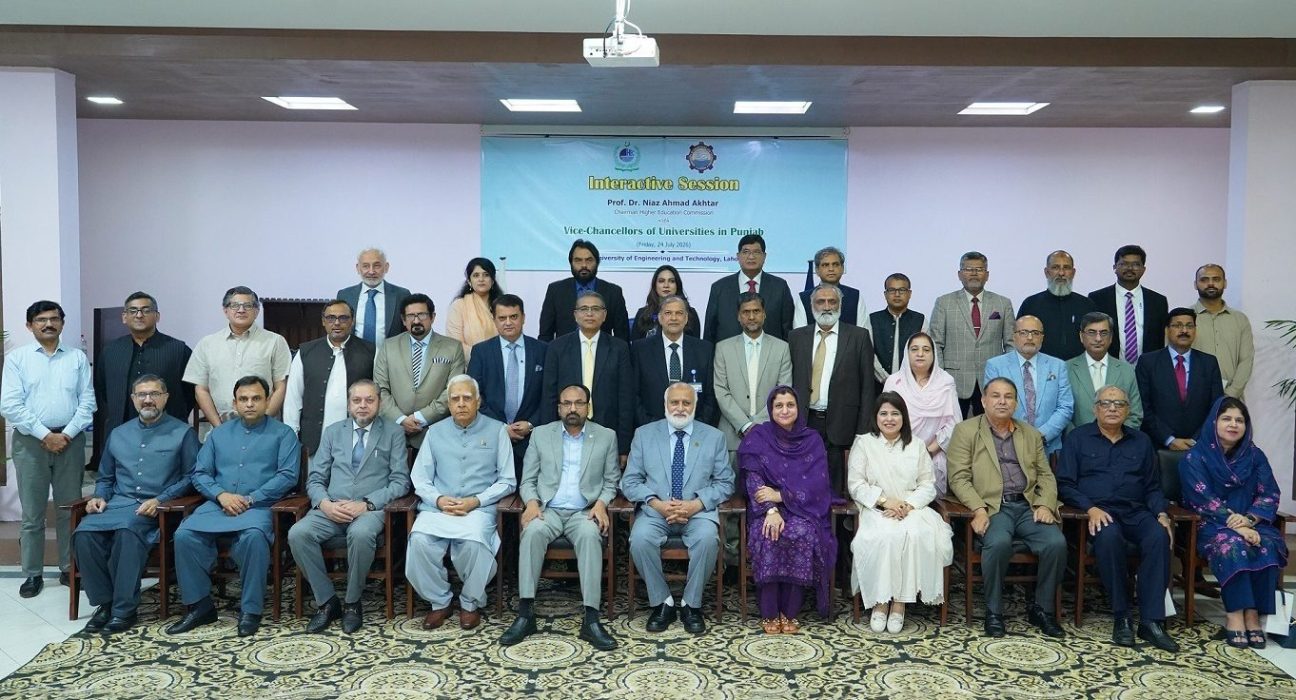
The initiative was announced during a high-level interactive meeting of vice chancellors from more than 80 public and private universities in Punjab, held at the University of Engineering and Technology (UET) Lahore. The session was chaired by HEC Chairman Prof Dr Niaz Ahmad Akhtar and hosted by UET Vice Chancellor Prof Dr Shahid Munir. Vice Chancellor of the University of the Punjab, Prof Dr Muhammad Ali, also attended the meeting.
Addressing the participants, Prof Dr Niaz Ahmad Akhtar said Artificial Intelligence is reshaping higher education, industry and the global economy at an unprecedented pace. He stressed that universities must move beyond conventional teaching methods and adopt technology-driven education to equip graduates with the skills required for the future.
He directed universities to immediately review and modernize their curricula, degree programmes and academic systems in accordance with the Federal Government’s policy. He emphasized that institutions should focus on producing graduates with practical expertise, digital competencies and innovation-driven mindsets instead of relying solely on traditional academic models.
The HEC chairman called for the integration of AI, Data Science, Robotics, Cybersecurity, Biotechnology, Digital Technologies, Innovation and Entrepreneurship into academic programmes to prepare students for the rapidly evolving global job market and industry demands.
Welcoming the participants, UET Lahore Vice Chancellor Prof Dr Shahid Munir highlighted the university’s progress in Artificial Intelligence, advanced research and digital technologies. He announced that UET Lahore has already introduced AI-focused degree programmes, specialized courses and research initiatives, and is ready to share its curriculum, teaching resources and academic expertise with universities across Pakistan.
He underscored the importance of stronger collaboration among higher education institutions, resource sharing and joint academic initiatives to accelerate AI adoption, strengthen research capacity and improve the global competitiveness of Pakistan’s universities.
During the interactive session, vice chancellors discussed strategies for integrating AI into teaching, research, curriculum development, digital learning and university administration. Participants also highlighted financial, administrative and academic challenges facing higher education institutions and presented recommendations to the HEC chairman.
Related: HEC Scholarship Supports Over 46,800 Deserving Students
The meeting concluded with a question-and-answer session, reaffirming the participants’ commitment to implementing the Federal Government’s AI-driven education agenda. They pledged to strengthen research, innovation, industry collaboration and international partnerships to prepare globally competitive graduates capable of meeting future technological challenges.
