

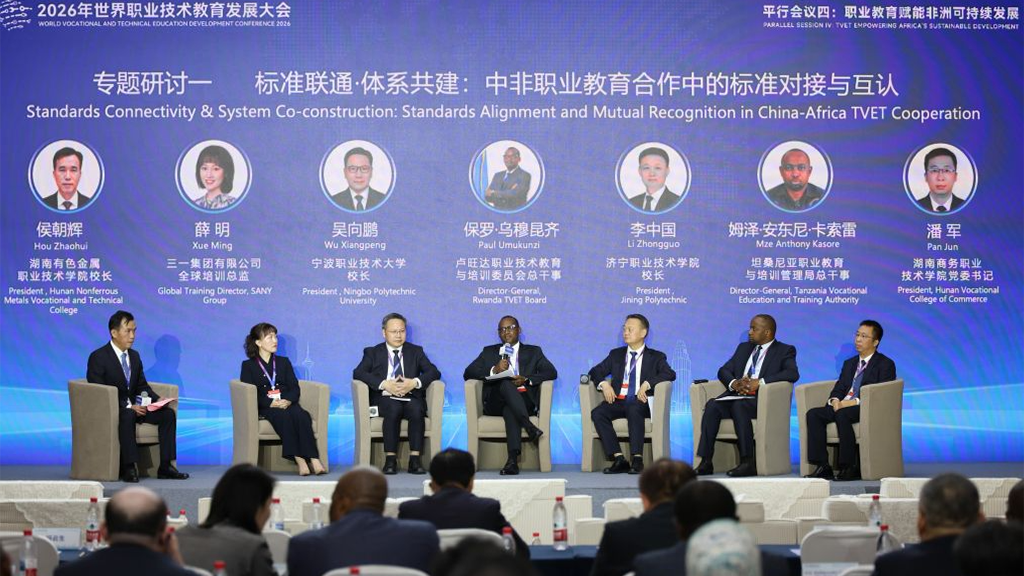
The World Vocational and Technical Education Development Conference 2026 concluded in Tianjin with a major international push to strengthen vocational education standards, industry partnerships, lifelong learning and skills development.
Held from October 15 to 17 under the theme “TVET: Co-Embracing Change, Co-Forging Standards, Co-Creating Future,” the conference brought together education officials, policymakers and representatives from across the world to discuss how vocational education can respond to technological change, evolving labour markets and the growing demand for skilled workers.
A key outcome was the release of the Framework of World Vocational and Technical Education Standards, known as the Beijing Agreement. The framework was jointly released by 45 countries at the closing ceremony and is described as the first international vocational education standard developed under China’s leadership.
The Beijing Agreement identifies economic and social development, human development, greater social equity, international skills exchange and preparation for future challenges as shared priorities for vocational education. It also calls for stronger vocational school systems, lifelong education and training, closer cooperation between educational institutions and industry, workplace-based practical training and the use of artificial intelligence to support teaching and learning.
The conference featured five main sessions, including the opening ceremony, plenary meeting, ministerial roundtable, parallel meetings and closing ceremony. Three major side events were also held: a 10th-anniversary symposium for China’s Luban Workshops, a special exhibition on Chinese vocational education and the final of the World Vocational College Skills Competition.
The skills competition reached a record international scale, with 9,391 teams and about 36,000 contestants from 78 countries across five continents. An Oceania division was added this year, while a new traditional Chinese craftsmanship category expanded the competition’s cultural dimension.
The conference also highlighted the expansion of the Luban Workshop initiative, which China has developed as a model for international vocational education cooperation. According to China’s Ministry of Education, 38 Luban Workshops have been established in 32 countries, providing degree and non-degree training and supporting cooperation between vocational institutions and industry.
The event marked the third World Vocational and Technical Education Development Conference since the series began in 2022. Organizers said the latest meeting represents a shift in international vocational education cooperation from personnel exchanges to project cooperation and increasingly toward cooperation based on shared standards.
Related: China and Pakistan Launch Vocational Education Partnership
The conference comes as governments and education systems worldwide face pressure to equip young people and workers with skills suited to artificial intelligence, digitalisation, green technologies and rapidly changing industries. The Beijing Agreement places these challenges within a broader international framework and could provide a reference point for future cooperation on vocational qualifications, curriculum development, skills training and quality assurance.
