

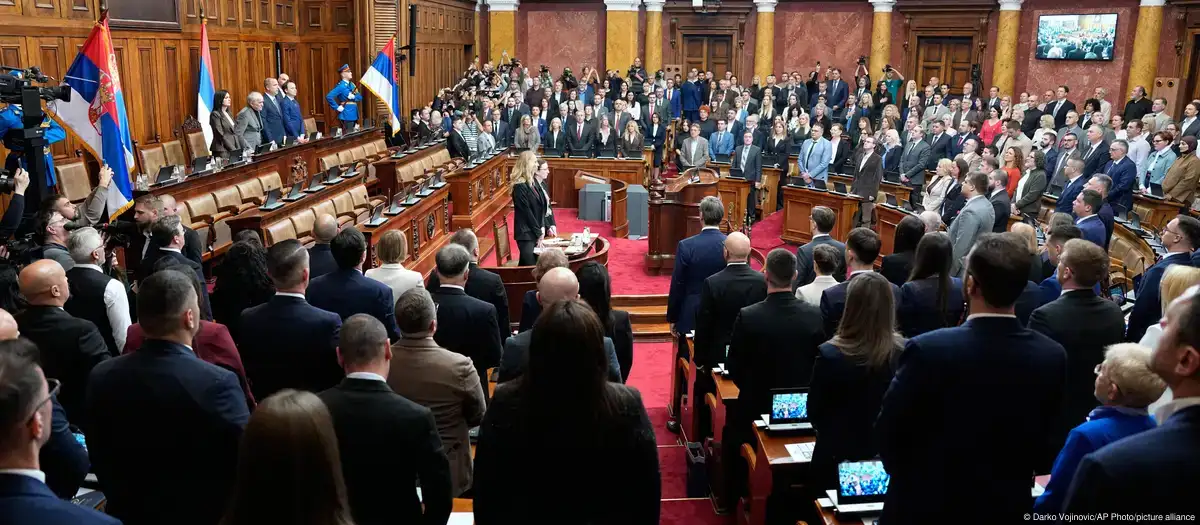
Serbia’s student-backed political movement has officially entered parliament after its candidates were sworn in as lawmakers on Tuesday, November 17, marking a major political shift following nearly two years of student-led protests against corruption and government accountability.
The newly elected representatives of the Students’ List took their seats during the inaugural session of Serbia’s National Assembly in Belgrade, following their victory in the October 25 snap parliamentary elections. The movement secured 140 of the 250 parliamentary seats, giving it a majority to form a government without coalition partners.
The election result ended the 14-year parliamentary dominance of the Serbian Progressive Party (SNS), led by former president Aleksandar Vučić. His political alliance secured 103 seats, while minority parties won the remaining seven.
Hundreds of supporters gathered outside the parliament to welcome the newly elected lawmakers, celebrating what has become one of the most significant political developments in Serbia’s recent history. The arrival of representatives from Vučić’s party was met with boos and protests from some members of the crowd.
The Students’ List emerged from a nationwide student movement that gained momentum following the collapse of a railway station canopy in the northern Serbian city of Novi Sad on November 1, 2024, killing 16 people.
The tragedy triggered widespread demonstrations over alleged corruption, government accountability and concerns about institutional transparency. University students initially led the protests, demanding justice for the victims and a transparent investigation into the disaster. Their campaign gradually attracted support from academics, teachers, professionals and other sections of society.
After months of demonstrations, the movement expanded its demands to include political reforms and early parliamentary elections. It eventually transformed into an electoral platform bringing together candidates from academic, professional, scientific and cultural backgrounds.
Unlike traditional political parties, the Students’ List includes university academics, lawyers, scientists, activists and other professionals, many of whom have limited experience in parliamentary politics.
With their election victory now translated into parliamentary representation, the lawmakers face the challenge of turning their protest movement’s demands into government policies and institutional reforms.
The new parliamentary majority has 90 days to form a government, nominate a prime minister and present its proposed programme for approval. Its stated priorities include tackling corruption, strengthening democratic institutions, improving healthcare and education, and addressing broader governance concerns.
The incoming government will also face important foreign policy challenges, including maintaining relations with Russia, pursuing Serbia’s long-standing ambition of joining the European Union and managing relations with Kosovo.
Former president Aleksandar Vučić, who resigned in September to pursue the premiership, has also taken his seat in the new parliament as an opposition lawmaker.
Related: Student Visa Limit Struck Down by US Court
The transition marks an unprecedented moment for Serbia, where a student-led protest movement has moved from university campuses and street demonstrations into the country’s highest legislative institution. Its ability to deliver on its reform promises will now be closely watched as the new parliament begins its work.
