

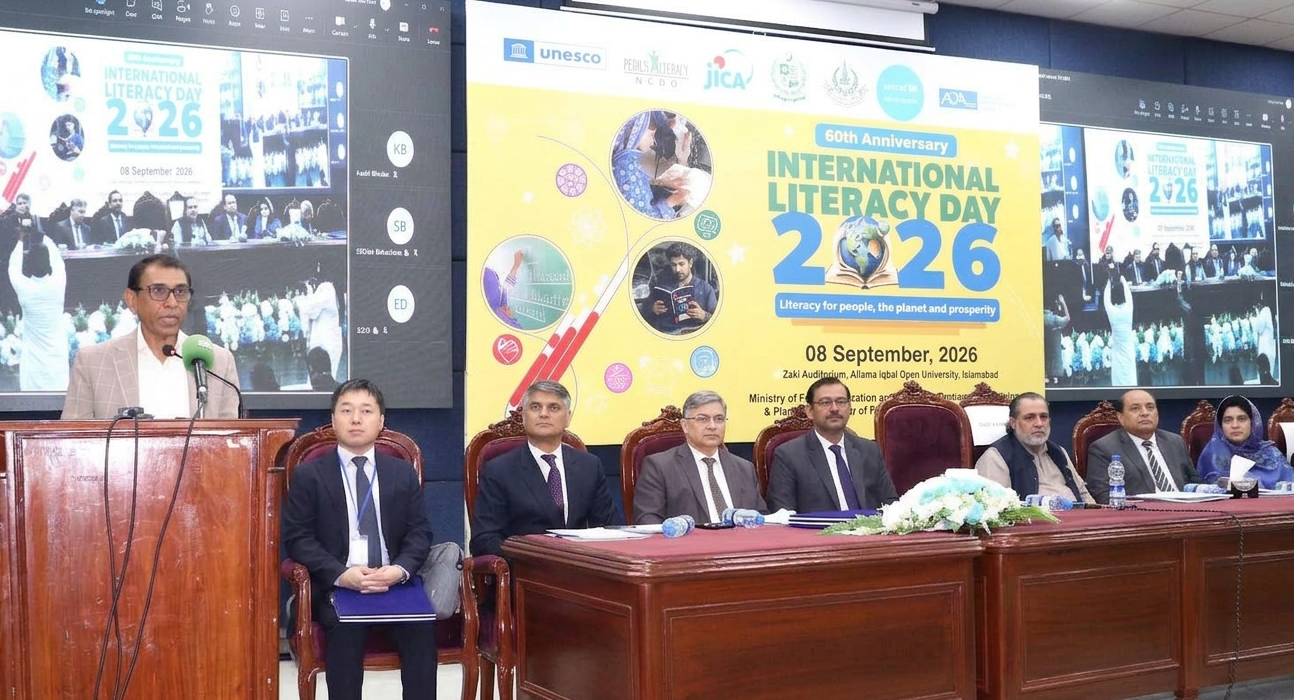
Pakistan can transform its 150 million young people into a skilled national asset by strengthening formal, non-formal and technical education systems, Federal Minister for Education and Professional Training (MoFEPT) Dr Khalid Maqbool Siddiqui said on International Literacy Day 2026.
Speaking at an event organized at Allama Iqbal Open University (AIOU) by the MoFEPT in collaboration with JICA, UNESCO and UNICEF, the minister emphasized the need for innovative approaches to literacy, non-formal education and skills development to prepare Pakistani youth for both domestic and international employment opportunities.
Dr Khalid Maqbool Siddiqui said Pakistan’s low literacy rate demands solutions that go beyond conventional educational models. He called for coordinated national efforts involving federal and provincial governments, educational institutions, development partners and civil society to address persistent literacy challenges, particularly in rural and underserved areas.
The minister proposed utilizing the country’s extensive network of mosques as short-duration learning centres between Ishraq and Dhuhr prayers. He said the initiative could provide accessible learning opportunities to people in communities where conventional educational facilities remain limited.
He stressed that despite decades of efforts, literacy in rural and underdeveloped regions continues to pose a significant challenge. Non-formal education, he added, can play a critical role in bringing out-of-school children and young people back into learning, particularly those affected by financial constraints, geographical barriers or limited access to formal institutions.
JICA Deputy Country Representative Takayuki Sugawara highlighted several initiatives aimed at connecting out-of-school children and adults with education and livelihood opportunities. These include JICA’s AQAL Project, the “Each One, Teach One” initiative and Recognition of Prior Learning (RPL), which helps individuals gain recognition for skills and experience acquired outside formal education systems.
Representatives from UNICEF, UNESCO, the National Commission for Human Development (NCHD) and AIOU reaffirmed their commitment to expanding access to quality alternative education and strengthening literacy and skills-development initiatives across Pakistan.
Provincial representatives also shared progress made in improving literacy and reducing the number of out-of-school children.
Balochistan reported an increase in its literacy rate from 42 percent to 49 percent, while the proportion of out-of-school children declined from 58 percent to 45 percent. Khyber Pakhtunkhwa reported a literacy rate of 51.09 percent, with 5.9 million students enrolled across more than 34,000 schools. Azad Jammu and Kashmir highlighted a PKR 52 million allocation under Education Policy 2025 aimed at enrolling 260,000 out-of-school children. Gilgit-Baltistan reported an 86 percent literacy rate, supported by a network of 3,149 educational institutions.
Related: Germany Opens Doors for Pakistani Nurses Amid Shortage
The International Literacy Day event underscored the need for Pakistan to integrate literacy, alternative education and market-oriented skills development into a coordinated national strategy. With its large youth population, the country faces both a major challenge and an opportunity to develop a workforce capable of meeting the demands of a rapidly changing domestic and global economy.
