

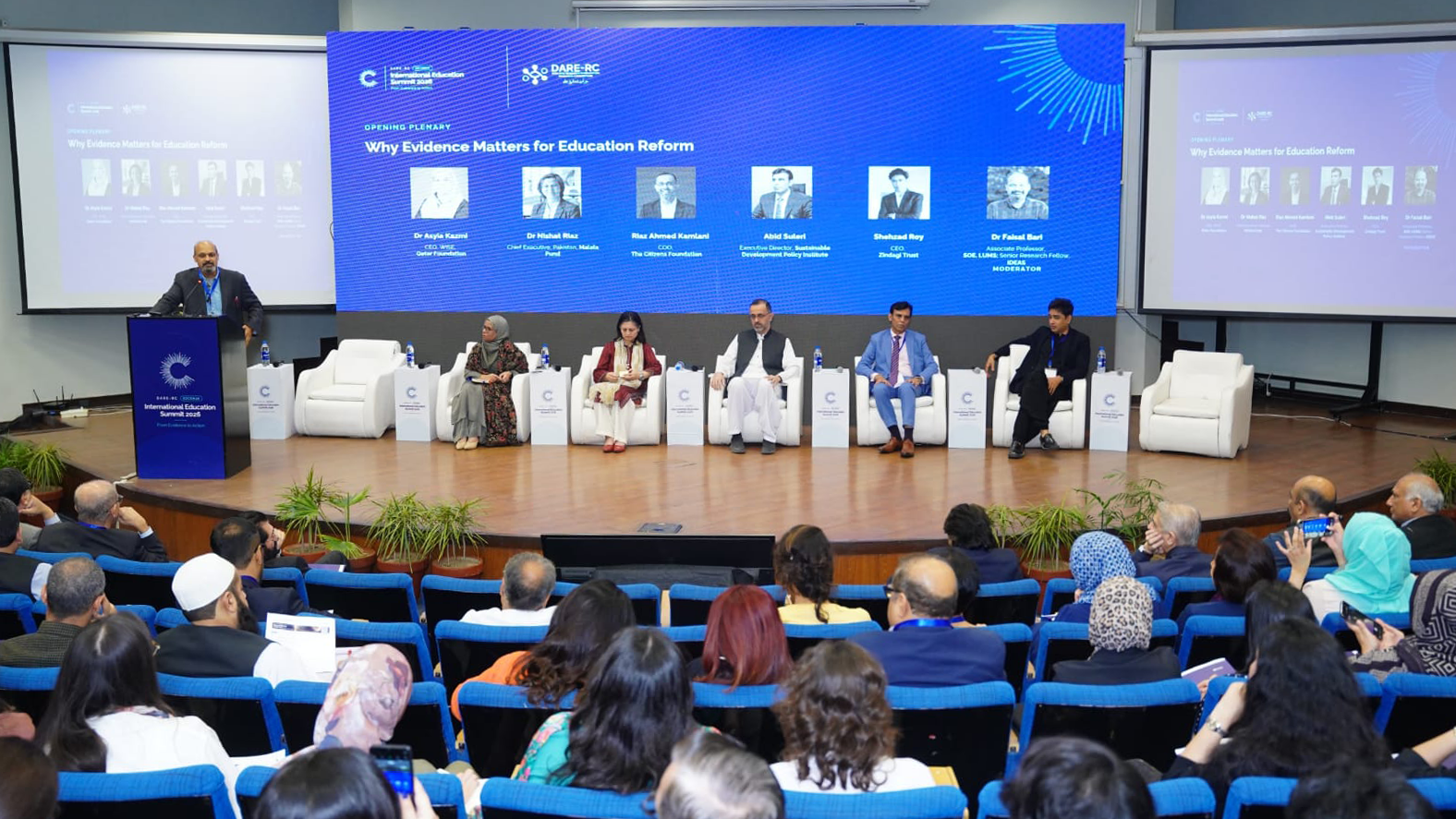
The DARE-RC International Education Summit 2026, known as EDCON26, has brought researchers, policymakers, education practitioners, funders and sector leaders together at the Lahore University of Management Sciences (LUMS) to identify priorities for evidence-based education reform in Pakistan.
Held on October 31 and November 1 under the theme “From Evidence to Action,” the two-day summit examined findings from 44 research studies and scoping papers produced through the Data and Research in Education Research Consortium (DARE-RC). The discussions focused on how research and reliable data can be translated into practical policies capable of improving education outcomes across Pakistan.
The summit was co-hosted by DARE-RC and the Syed Ahsan Ali and Syed Maratib Ali School of Education at LUMS. Its agenda covered data and artificial intelligence, teaching and the education workforce, inclusion and equity, climate resilience, governance and accountability, language policy and the scaling of education interventions.
Opening sessions featured British High Commission representatives, Federal Secretary of Education Nadeem Mahbub, LUMS Vice Chancellor Dr Ali Cheema and Dr Adil Najam, President of WWF International and former LUMS vice chancellor. Leading education voices including Shehzad Roy, Dr Asyia Kazmi, Nishat Riaz, Riaz Ahmed Kamlani and Abid Suleri also discussed why stronger links between evidence and education policy are essential for reform.
The second day shifted the focus from research findings to implementation. Sessions examined how evidence can influence government decisions, how successful education interventions can be scaled, and what conditions are required for reforms to work effectively. Three policy labs brought researchers and policymakers together to discuss future priorities in foundational learning and teaching quality, equity and inclusion, and governance, data and accountability.
Government participation included Federal Secretary of Education Nadeem Mahbub as well as officials from Punjab, Sindh, Balochistan and Khyber Pakhtunkhwa. The closing plenary further examined how research can move into government decision-making and ultimately influence education policy and practice.
The summit also marked the conclusion of the DARE-RC programme, a three-and-a-half-year FCDO-funded initiative managed by Oxford Policy Management, Aga Khan University Institute for Educational Development and Sightsavers. The programme was established to strengthen Pakistan’s education evidence base, build research capacity and support evidence-informed policymaking, particularly for children and communities facing marginalisation.
DARE-RC Research Director Dr Monazza Aslam said synthesising the programme’s research was particularly important because Pakistan’s education challenges are increasingly interconnected. Bringing individual studies together, she noted, can help identify what works, for whom and under what conditions, providing a stronger basis for developing equitable, effective and resilient education systems.
Related: LUMS Dialogue Highlights Digital Infrastructure and Skills Gap
Although the DARE-RC programme is concluding, its education summit series will continue through the LUMS School of Education. The continuation is intended to preserve the link between academic research, policymakers and practitioners and maintain a platform for evidence-driven education reform in Pakistan.
