

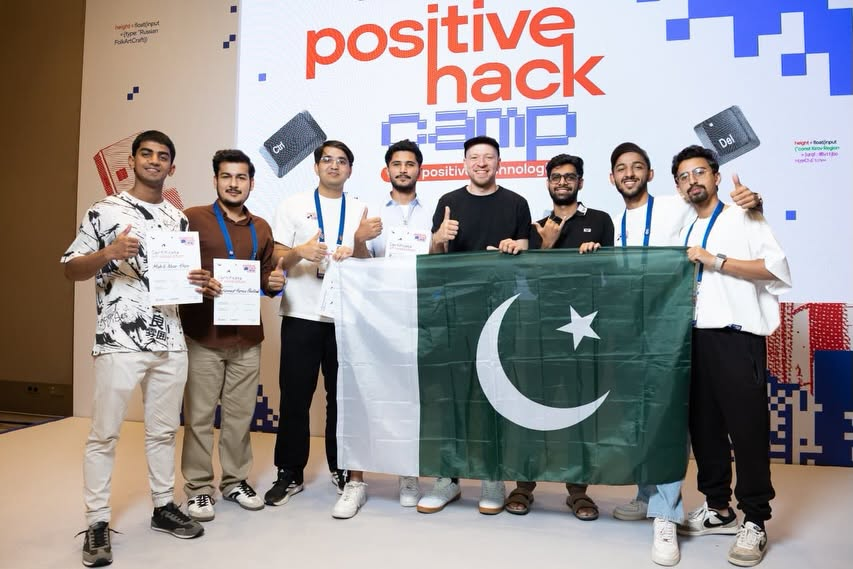
Pakistani cybersecurity talent has made a strong mark at Positive Hack Camp 2026 in Moscow, with Air University alumni Muhammad Hamza Khattak and Hamza Haroon securing runner-up positions at the international cybersecurity programme.
The achievement was highlighted by Air University, which described the performance as a proud moment for the university, its National Cyber Security Academy (NCSA) and Pakistan. Hamza Khattak finished as the first runner-up, while Hamza Haroon secured the second runner-up position.
The two-week Positive Hack Camp 2026 brought together more than 80 early-career cybersecurity specialists from 20 countries. Organised by Positive Technologies and Positive Education with support from Russia’s Ministry of Digital Development, the programme was held in Moscow from July 25 to August 9.
The 2026 edition attracted more than 800 applications, with organisers selecting a limited group of participants following a competitive screening and interview process. Selected participants represented countries across Asia, the Middle East, Africa and Latin America.
The camp focused on intensive, practical cybersecurity training rather than classroom-based instruction alone. Participants worked through controlled real-world attack scenarios and received training covering reconnaissance, initial access, web exploitation, privilege escalation, lateral movement, Active Directory compromise and detection evasion. The programme included 30 hands-on sessions led by cybersecurity specialists, reverse engineers and ethical hackers.
The success of Hamza Khattak and Hamza Haroon is particularly significant for Air University’s cybersecurity ecosystem. Both are associated with the university’s Cyber Security Society, whose Hall of Fame records their previous achievements in national and international cybersecurity competitions. Hamza Haroon is listed among the society’s prominent cybersecurity performers, while Hamza Khattak is also recognised for achievements in competitions including BlackHat, Ignite and the Pakistan Cybersecurity Challenge.
The Moscow achievement comes at a time when cybersecurity skills are becoming increasingly important for national resilience, digital infrastructure and economic security. Positive Technologies said the Positive Hack Camp is designed to help develop the next generation of cybersecurity professionals and strengthen cyber resilience and digital sovereignty through practical skills and international knowledge exchange.
Related: Pakistan Shines at Nuclear Olympiad with 3 Medals
For Pakistan, the performance of its young cybersecurity professionals on an international platform provides another indication of the country’s growing pool of technically skilled talent. For Air University and NCSA, the success of their alumni offers a notable example of how academic training, cybersecurity communities and practical competition experience can translate into international recognition.
