

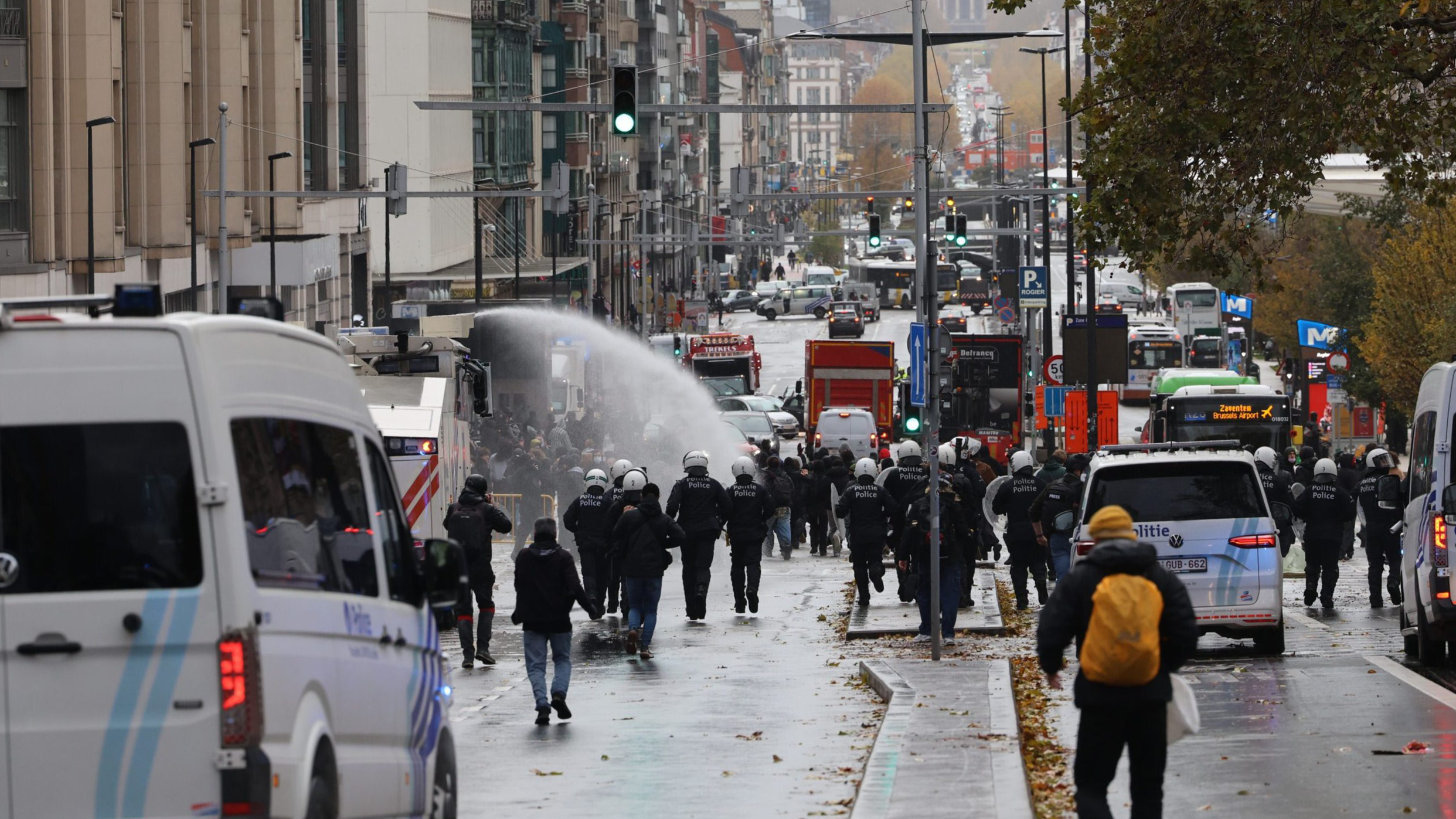
Thousands of students, teachers and trade union members took to the streets of Brussels on Tuesday, November 17, to protest rising university tuition fees, education reforms and government spending cuts, with demonstrations turning tense after riot police charged crowds and used tear gas and water cannons to disperse protesters.
The demonstration, organised by the Federation of French-speaking Students (FEF) on International Students’ Day, brought together students from French- and Dutch-speaking educational institutions, alongside teachers, railway workers, metalworkers and trade union representatives.
Police estimated that approximately 3,200 people participated in the march, while organisers claimed the turnout reached 15,000. Despite heavy rain and strong winds, protesters gathered outside Brussels Central Station before marching towards the headquarters of the Wallonia-Brussels Federation government at Place Surlet de Chokier.
The protesters opposed a series of education policies they believe are making higher education increasingly expensive and less accessible. Their concerns included higher university registration fees, reductions in education funding, deteriorating study conditions and rising living expenses, particularly accommodation, transportation and food.
One of the major points of contention is the increase in annual higher education registration fees in French-speaking Belgium from €835 to €1,194, representing an increase of approximately 43 per cent. The revised fees affect around 58 per cent of students from the 2026-27 academic year.
Students have also raised concerns about changes to financial assistance and education funding, particularly in the Flemish-speaking education system, where restrictions on study grants have added to concerns about affordability.
The march initially proceeded largely peacefully, with demonstrators carrying placards, chanting slogans and demanding that authorities reconsider the measures. However, tensions escalated after the main demonstration ended around 1:30 p.m., when groups of protesters moved towards the city’s inner ring road and attempted to reach the headquarters of the Les Engagés political party.
Police subsequently moved against the crowds near Botanique and Place Rogier, deploying water cannons and tear gas. Officers in riot gear charged demonstrators as protesters blocked roads and attempted to prevent police vehicles from advancing.
Several demonstrators were arrested during the police operation, including at least one minor, according to local media reports. Witnesses also reported seeing young protesters being taken away with visible marks on their bodies, although the circumstances were not immediately established.
The clashes caused significant traffic disruption in central Brussels, particularly around the inner ring road. Police eventually dispersed the crowds and reopened the road to traffic at approximately 3 p.m.
The demonstration also highlighted growing cooperation between student organisations and trade unions against government austerity measures. The participation of Flemish students alongside their French-speaking counterparts was particularly significant, bringing together groups that have traditionally organised protests separately.
FEF president Lénaïk Dumont said the turnout demonstrated the importance of solidarity between students and workers, arguing that their struggles against austerity and deteriorating living conditions were closely connected.
Student organisations have warned that the movement will continue in the coming weeks, with further demonstrations expected as opposition to education reforms and spending cuts grows.
Related: Brazilian Students Take Protest to Heart of Financial District
The Brussels protest reflects wider concerns across Europe over the rising cost of higher education, reduced public funding and the financial pressures facing students. For many demonstrators, the issue is not simply higher tuition fees but whether higher education will remain financially accessible to young people from ordinary and low-income families.
