

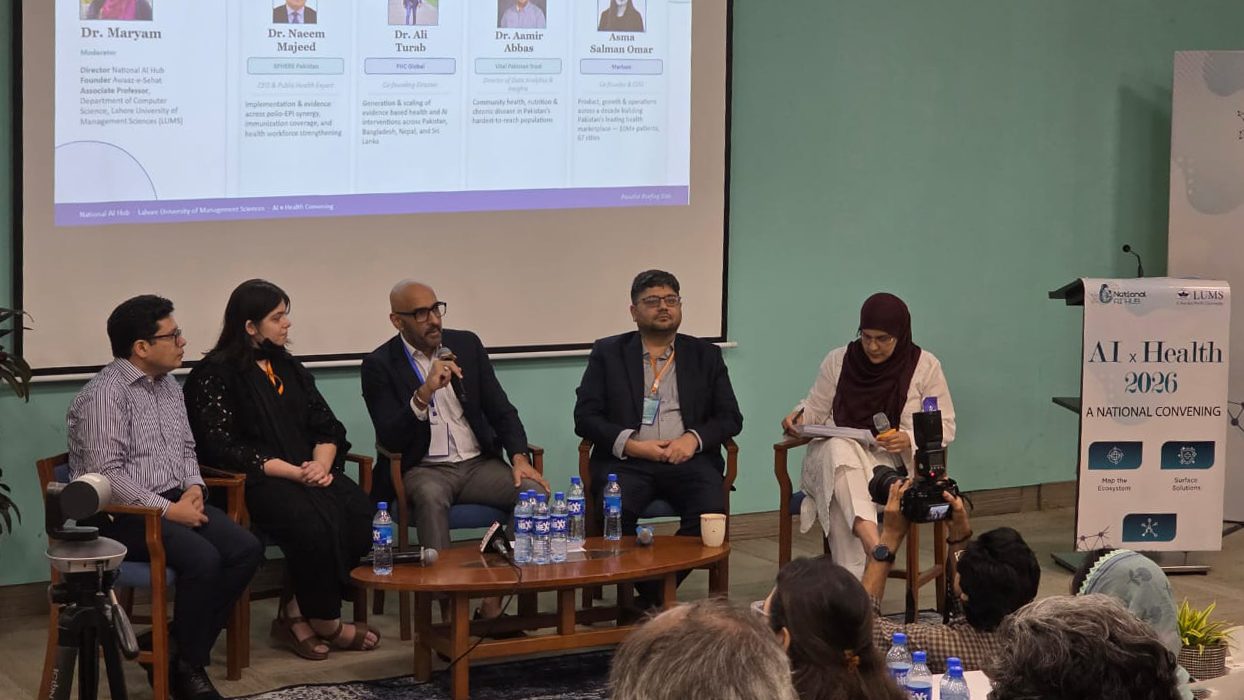
Pakistan’s healthcare and technology sectors converged at the country’s first national convening dedicated to artificial intelligence in healthcare, where experts highlighted both the promise of AI-driven innovation and the major structural barriers slowing digital transformation in the health sector.
Organised under the National AI Hub by Lahore University of Management Sciences (LUMS), the event brought together researchers, clinicians, policymakers, startup founders, public health professionals and industry leaders to explore how artificial intelligence can improve healthcare delivery across Pakistan.
The convening focused on identifying practical ways AI can support the country’s healthcare system while addressing long-standing challenges such as fragmented health data, weak digital infrastructure and the lack of coordinated governance frameworks.
Opening the session, Shahid Hussain stressed that meaningful advancement in AI-powered healthcare would only be possible through collaboration between technology experts, healthcare professionals, researchers and policymakers.
Speaking at the event, Ali Cheema said Pakistan’s healthcare crisis requires broad systemic reform instead of isolated technological fixes. He noted that despite being a middle-income country, Pakistan continues to experience maternal and neonatal mortality rates comparable to low-income nations.
He added that rapid population growth and insufficient healthcare spending are placing increasing pressure on already overstretched medical systems. While acknowledging AI’s transformative potential, he cautioned against viewing technology as a standalone solution without proper governance, ethical oversight and institutional reforms.
Maryam Mustafa said the convening aimed to build a shared understanding of Pakistan’s emerging AI-health ecosystem and encourage collaboration between institutions that often operate independently.
“Pakistan has the pieces, but it has yet to draw the map,” she remarked, highlighting duplication of efforts, disconnected health databases and the absence of shared digital infrastructure as major obstacles to innovation.
Throughout the day, participants showcased AI-based healthcare tools and pilot projects focused on maternal and newborn care, digital health services, clinical decision support systems and language-based AI applications.
A panel discussion featuring technology leaders and public health experts identified the lack of interoperable health data systems, scalable digital infrastructure and effective governance mechanisms as key barriers preventing wider AI adoption in Pakistan’s healthcare sector.
Related: LUMS Summit Sparks Debate on Digital Asset Regulation
Participants agreed that while innovation in health technology is growing rapidly in Pakistan, sustainable long-term impact will depend on stronger coordination between government institutions, hospitals, researchers and technology developers to create integrated and accessible healthcare systems nationwide.
