

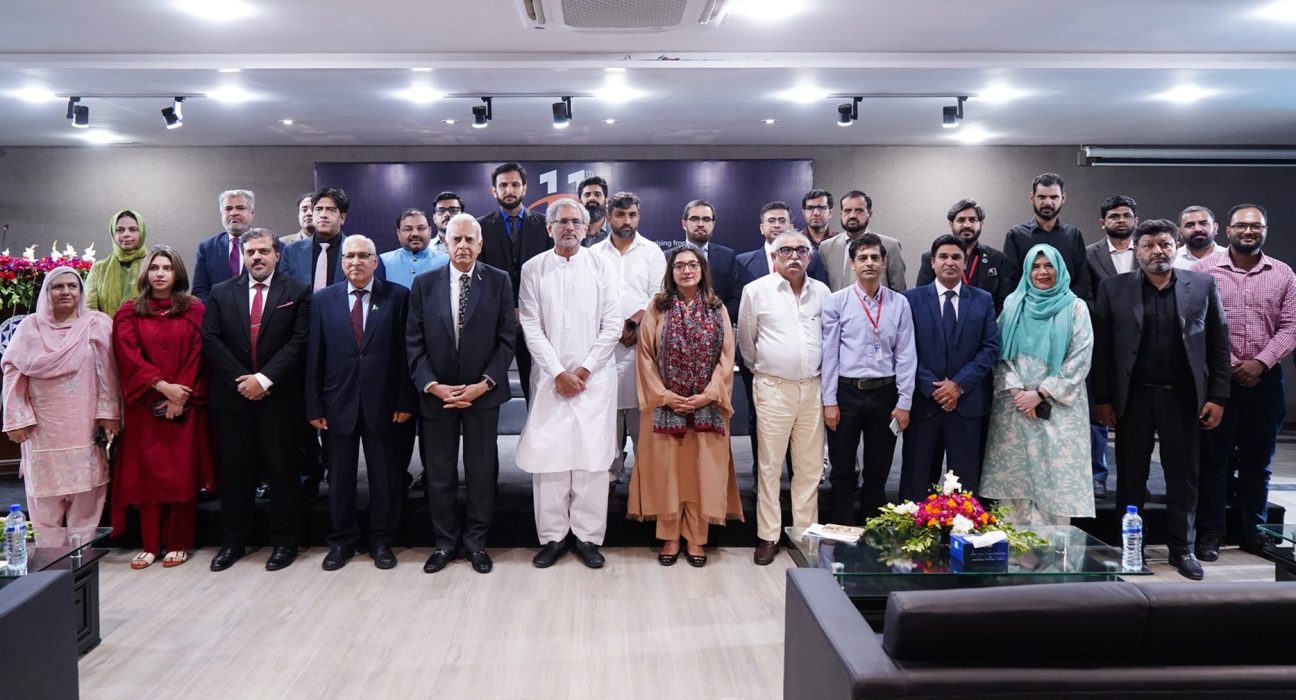
The University of Management and Technology (UMT) hosted the 11th Budget Summit 2026-27, bringing together leading economists, policymakers, industrialists, academics, and business leaders to discuss Pakistan’s pressing economic challenges, fiscal reforms, and long-term growth strategy.
The summit featured prominent speakers including former Prime Minister Shahid Khaqan Abbasi, former FBR Chairman Shabbar Zaidi, CEO Abacus Fatima Asad Saeed, former PIDE Vice Chancellor Dr Nadeem Ul Haque, ICMA Vice President Muhammad Yaseen, and UMT Rector Dr. Asif Raza.
Addressing the summit as chief guest, Shahid Khaqan Abbasi stressed that Pakistan’s economic future depends on political stability, policy continuity, industrial expansion, and institutional reforms. He said nations progress through effective policymaking, transparency, hard work, and good governance rather than short-term solutions.
Abbasi described the national budget as a comprehensive reflection of state revenues and expenditures, warning that excessive taxation across multiple sectors ultimately places additional burden on ordinary citizens. He noted that the salaried class continues to shoulder the heaviest share of taxes while national expenditures have surpassed income levels, making structural reforms unavoidable.
He further stated that Pakistan repeatedly faces foreign exchange crises whenever economic growth accelerates, eventually forcing the country to seek assistance from the IMF. According to Abbasi, sustainable industrial growth and export development remain essential for overcoming recurring economic instability.
Former FBR Chairman Shabbar Zaidi emphasized the need for deep structural tax reforms and improved governance. He observed that the corporate sector currently faces an effective tax burden of nearly 51 percent, while taxation pressure remains concentrated on a small number of companies and salaried citizens.
Zaidi argued that Pakistan’s primary challenge extends beyond corruption and lies in weak governance, flawed policymaking, and institutional inefficiency. He stated that without a clear economic roadmap, transparent governance, and policy consistency, the country would struggle to overcome its economic crisis.
Speaking on the occasion, Fatima Asad Saeed highlighted the importance of economic stability, investment-friendly policies, and relief for tax-paying segments of society. She stressed that budget planning must protect the interests of low- and middle-income groups, particularly salaried individuals.
Dr Nadeem Ul Haque underlined the role of research, evidence-based policymaking, and institutional reforms in achieving sustainable economic development, while Muhammad Yaseen emphasized fiscal discipline and effective financial management strategies.
UMT Rector Dr Asif Raza said universities, youth, and research institutions have a critical role in strengthening Pakistan’s economic future. He emphasized the importance of equipping young people with innovation, research capabilities, and practical skills to address future economic and financial challenges.
Related: UMT Students Excel in National Skills Competency Test 2026
Experts participating in the summit also presented recommendations for Budget 2026-27 focusing on fiscal transparency, tax reforms, economic stability, and sustainable long-term growth. The event concluded with commemorative souvenirs being presented to distinguished guests by the UMT rector.
