

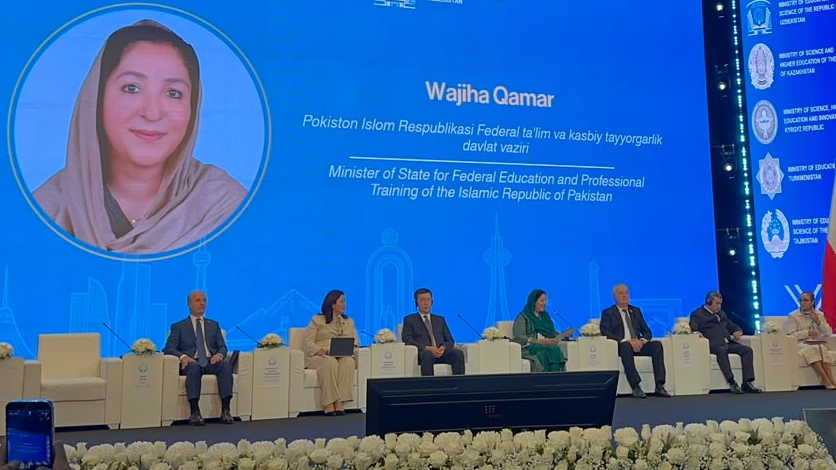
The Central Asia International Education Forum 2026 in Tashkent has brought Pakistan’s push for deeper educational cooperation with Uzbekistan and other Central Asian countries into focus, with Minister of State for Federal Education and Professional Training (MoFEPT) Wajiha Qamar calling for stronger academic mobility, joint degrees and collaborative research.
The forum, held on October 28 at the Uzbekistan Palace of International Forums, brought together education ministers, university leaders, international organizations and experts from across the region. More than 1,500 participants were expected, with representatives from all five Central Asian states as well as Türkiye and other partner countries. Its broader theme was “Central Asia — A New Space for Education, Science and Innovation,” while the education ministers’ roundtable focused on developing a common educational space and international cooperation.
Addressing the opening ceremony, Qamar said Pakistan wanted to transform its historic links with Uzbekistan and Central Asia into practical academic partnerships that create opportunities for students, researchers and young professionals. She highlighted the centuries-old intellectual connections associated with Samarkand, Bukhara and Tashkent, saying the region’s shared educational heritage could provide a foundation for modern cooperation.
Qamar proposed expanding student and faculty exchanges, developing joint degree programmes, facilitating mutual recognition of academic qualifications and increasing collaborative research. She identified artificial intelligence, engineering, medicine, agriculture, mining, renewable energy and language education as areas with significant potential for cooperation between Pakistan and Uzbekistan.
She also emphasized the importance of linking universities more closely with industry so that academic partnerships produce innovation, employment and practical skills. Greater academic mobility, stronger university-industry cooperation and wider access to education for women and underserved communities were identified as key priorities.
The forum’s official programme placed academic mobility, joint degrees, mutual recognition of diplomas and qualifications, joint research projects and education quality among its central areas of discussion. It also featured the “Study in Uzbekistan” exhibition and partnership meetings between universities, reflecting Uzbekistan’s wider effort to expand international higher education cooperation.
Qamar pointed to existing institutional engagement, including cooperation involving Pakistan’s National University of Sciences and Technology and Uzbekistan’s University of Geological Sciences, as examples of the partnerships that could be expanded. Pakistan and Uzbekistan have also been discussing broader cooperation in higher education, vocational training, scientific research and exchanges of students and faculty.
The minister said Pakistan was strengthening research and international academic partnerships through the Higher Education Commission, while NAVTTC was focused on developing market-relevant technical and vocational skills. She also linked international cooperation to Pakistan’s broader efforts to improve education access, learning outcomes and human capital development.
The Central Asia forum comes as Uzbekistan continues to expand its international education links. According to the forum’s organizers, the country now has more than 210 higher education institutions and about 1.7 million students, while international cooperation and foreign student participation have grown significantly in recent years.
Qamar stressed that educational cooperation should produce measurable benefits rather than remain limited to formal agreements. She said the success of partnerships should ultimately be judged by their impact on students, researchers and communities.
Her participation, alongside senior Pakistani education officials including Higher Education Commission (HEC) Executive Director Professor Dr Zia Ul Haq, signals Islamabad’s interest in using education, research and skills development as a bridge for deeper regional connectivity.
Related: 500,000 Chromebooks for Students in Pakistan
The forum is expected to support new academic exchanges, joint education programmes, research projects and inter-university partnerships, potentially giving Pakistan and Central Asian countries a broader platform for cooperation in education, science and innovation.
