

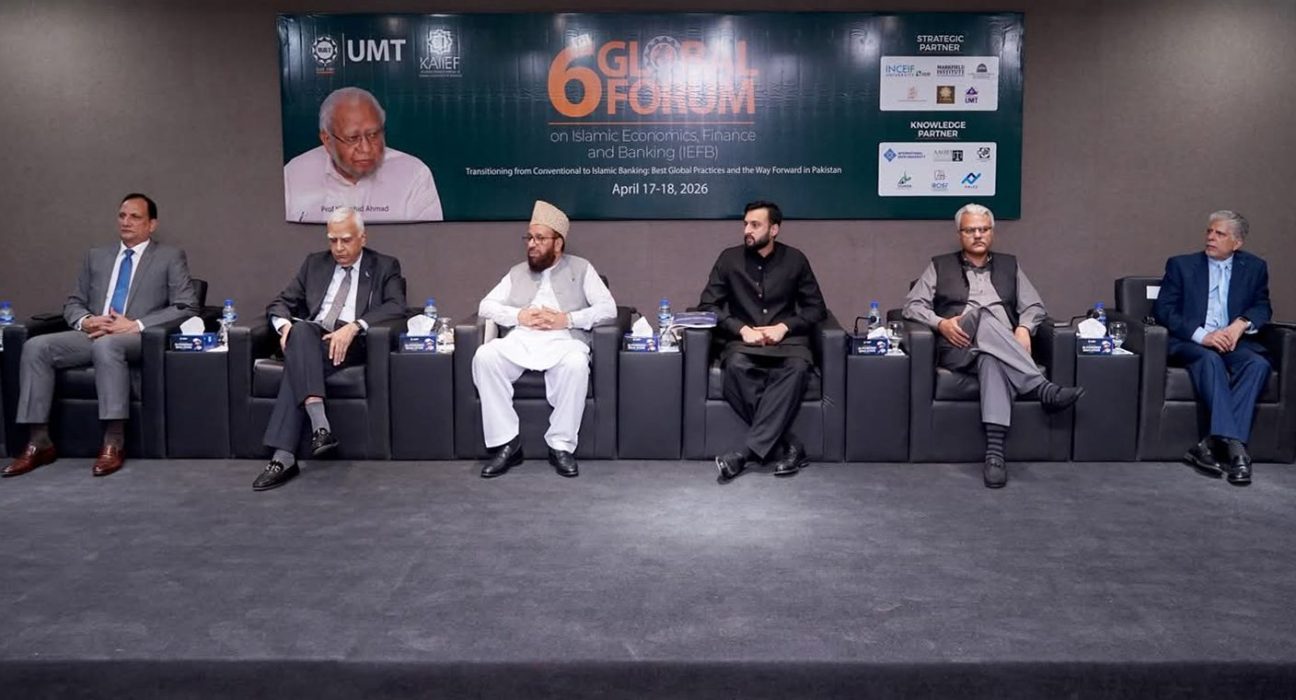
The University of Management and Technology (UMT) positioned itself at the center of global discourse on Islamic finance as it convened leading policymakers, economists and international voices at its 6th Global Forum on Islamic Economics, Finance and Banking in Lahore, reinforcing its role as a thought leader in shaping equitable financial systems.
Organized by the Khurshid Ahmad Institute of Islamic Economics and Finance, the high-profile forum gathered a diverse audience of national and international experts, regulators, business leaders and students, creating a platform for critical dialogue on transitioning from conventional to Islamic financial models. Federal Minister for Religious Affairs Sardar Muhammad Yousaf attended as chief guest, while UMT Chairman Ibrahim Hasan Murad, State Bank of Pakistan Executive Director Ghulam Muhammad Abbasi, Securities and Exchange Commission Commissioner Imtiaz Haider and FPCCI President Zaki Ijaz were among the prominent participants. Malaysian Prime Minister Anwar Ibrahim addressed the forum virtually.
Speaking at the event, Sardar Muhammad Yousaf praised UMT for hosting a significant international gathering and emphasized that Islamic economic principles offer a viable framework for sustainable growth, welfare and long-term stability. He stressed that educational institutions must play a leading role in advancing Islamic finance and reiterated his stance against interest-based systems, highlighting ongoing efforts to move toward their elimination. He also noted that the leadership of Shehbaz Sharif and Asim Munir is strengthening Pakistan’s global standing.
UMT Chairman Ibrahim Hasan Murad underscored the structural challenges facing Pakistan’s economy, pointing out that a substantial portion of national resources is consumed by interest-based debt repayments. He drew attention to global wealth inequality, noting that nearly half of the world’s wealth is concentrated among a small elite, and argued that Islamic finance offers a pathway to reducing corruption and economic injustice. He called for robust policymaking to facilitate the transition toward a more balanced and ethical financial system.
In his virtual address, Malaysian Prime Minister Anwar Ibrahim paid tribute to the contributions of Dr Khurshid Ahmad in advancing Islamic economics and urged collective efforts to address the economic challenges confronting the Muslim world. UMT leadership also emphasized the need to restructure economic systems in line with Shariah principles to ensure fairness and sustainability.
Business and regulatory leaders echoed similar sentiments, with FPCCI President Zaki Ijaz highlighting the potential of Islamic finance to alleviate poverty through interest-free financial support for young entrepreneurs. State Bank Executive Director Ghulam Muhammad Abbasi noted that expanding Islamic banking would strengthen transparency, social justice and financial equilibrium across the economy.
Related: UMT Launches Executive Education Series for Pakistan’s Leaders
The forum concluded with in-depth discussions among global experts on the challenges and opportunities in shifting from conventional banking to Islamic financial systems, signaling a growing consensus on the relevance of ethical finance in addressing modern economic disparities. The event closed with UMT honoring distinguished participants, further cementing its reputation as a key platform for intellectual and policy-driven engagement in Islamic finance.
